Originality AI Detector Review 2026: Not the Best Option?
Originality AI has serious publishing tools, yet its sensitive scoring creates trouble for short, formal, or AI-edited writing. For routine checks, Clever AI Detector is the easier place to start.
Originality AI is useful for publisher-scale screening, but its scores need more interpretation than the polished report suggests. False-positive concerns, expiring monthly credits, plus a $14.95 monthly price make Clever AI Detector the better first option for quick personal checks.
The biggest risk is treating a probability score as proof, especially with formal prose, short passages, or writing touched by Grammarly-style editing tools.
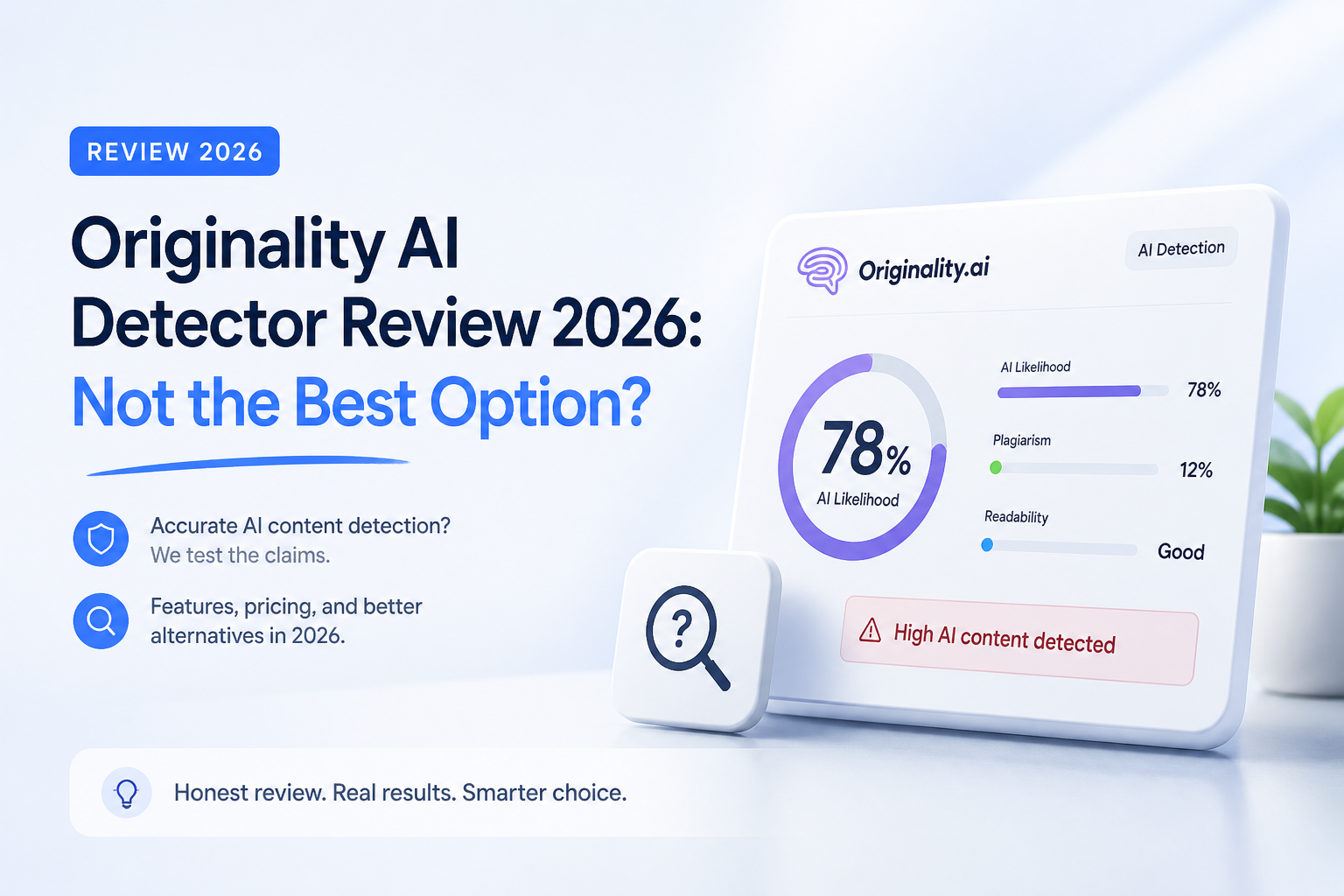
Originality AI Detector at a Glance
5.8/10Originality AI is a web-based detector built mainly for publishers, agencies, schools, plus content teams. It estimates whether text shows machine-generated patterns, with optional plagiarism or editorial checks.
Best forPublishing teams that need reports, URL scans, shared history, plus workflow controls
- AI-likelihood scoring
- Sentence-level highlighting
- Plagiarism checking
- Writing Replay extension
- Team tools plus API access
- Good publisher workflow
- Useful sentence highlights
- Supports 30 languages
- Scores can be overinterpreted
- Subscription credits expire monthly
- Routine AI editing may raise flags
Originality AI Detector Review: How It Scored Across Five Criteria
| Category | Performance | Score |
|---|---|---|
| 01 Detection Reliability | 6.4/10 | |
| 02 Result Clarity | 6.7/10 | |
| 03 False-Positive Handling | 4.3/10 | |
| 04 Publisher Workflow Tools | 7.9/10 | |
| 05 Plans & Free Access | 3.8/10 |
How We Evaluated Originality AI Detector for This 2026 Review
We examined the free-check workflow, paid-plan structure, score explanations, false-positive guidance, privacy language, report features, plus public user experiences. The review emphasized realistic problem cases such as formal essays, short introductions, edited human prose, mixed-origin drafts, plus routine publisher content.
Scores reflect practical usefulness rather than the vendor's advertised accuracy figure. We gave extra weight to false-positive handling because an incorrect flag can matter more than a missed low-stakes blog draft.
When Originality AI Detector Is the Wrong Tool
Avoid using Originality AI as the deciding voice in grading, hiring, disciplinary reviews, or payment disputes. It is also a poor fit for tiny samples, rigid academic formats, public-domain passages, plus documents heavily edited through AI-powered grammar software.
If the outcome affects a real person, inspect revision history, sources, notes, prior writing, plus contextual evidence. A detector can point toward a closer look. It cannot reliably reconstruct how a document was created.
Originality AI Detector Performance in Everyday Writing Checks
01 Detection Reliability
Useful signals, not dependable authorship proof
6.4/10
Detection Reliability
Useful signals, not dependable authorship proof
Originality AI was strongest with long, untouched machine drafts. The trouble appeared with mixed material, polished human prose, plus passages edited through writing assistants. Those cases often produced a confident-looking score without enough context to explain who wrote what.
The company itself describes its result as a probability rather than a verdict. That distinction matters. A 90% AI score does not mean 90% of the document was generated by AI. It reflects the model's confidence that AI influenced some part of the text.
- Catches obvious raw AI output well
- Supports long-form editorial screening
- Offers models for different detection needs
- Sentence-level highlighting helps locate suspicious patterns
- Mixed human-AI drafts can be difficult to interpret
- Formal or formulaic prose may receive inflated scores
- A confident percentage can encourage overreach
02 Result Clarity
Clean reports with a confusing headline percentage
6.7/10
Result Clarity
Clean reports with a confusing headline percentage
The dashboard is organized well. Highlights, scan history, downloadable reports, plus shareable results are easier to navigate than the clutter found in many detector products.
The weak spot is the main percentage. Readers may assume it measures the portion of AI-written words, though Originality AI says it is a confidence score. That mismatch can turn a screening result into a false accusation if nobody reads the supporting guidance.
- Readable sentence highlights
- Downloadable PDF reports
- Shareable scan links
- Stored history for paid accounts
- Headline score invites the wrong interpretation
- Highlights do not establish authorship
- Different scan models add another decision
03 False-Positive Handling
The main reason for our negative verdict
4.3/10
False-Positive Handling
The main reason for our negative verdict
Originality AI openly lists short passages, academic writing, public-domain text, formulaic structures, plus AI-powered editing as possible sources of misleading results. Its help material even notes that Microsoft Word Editor or Grammarly-style changes can raise a score.
That creates an awkward practical problem. A person can write a draft, accept routine grammar fixes, then look more suspicious afterward. The company recommends checking longer samples plus reviewing writing history, which is sensible, but it also proves the detector cannot safely carry the decision by itself.
- Official documentation acknowledges false positives
- Writing Replay can provide useful process evidence
- Multiple samples can establish a writer baseline
- Normal editing software may affect the result
- Short formal passages are particularly risky
- Disputing a score requires evidence outside the detector
04 Publisher Workflow Tools
The strongest part of the package
7.9/10
Publisher Workflow Tools
The strongest part of the package
This is where Originality AI makes the most sense. Agencies can upload documents, scan URLs, tag checks, manage team roles, use an API, plus combine AI detection with plagiarism or readability tools.
The Chrome extension's writing replay is more meaningful than a detector score alone because it can show how a document developed. Large editorial teams may value that audit trail, though individual writers probably will not use enough of the surrounding toolkit to justify a subscription.
- Document plus URL scanning
- Team roles with scan tags
- API access on higher plans
- Writing Replay adds process context
- Plagiarism checks fit editorial review
- Several tools are excessive for occasional users
- API access requires the expensive Enterprise tier
- More features do not fix uncertain classifications
05 Plans & Free Access
A limited sampler followed by expiring credits
3.8/10
Plans & Free Access
A limited sampler followed by expiring credits
The public checker allows three free scans per day with up to 2,000 words per scan. That is enough for a quick test, but full workflow access sits behind a subscription.
Pro costs $14.95 monthly or $12.95 per month with annual billing. It includes 2,000 monthly credits, with one credit covering 100 words for an AI-only check. Unused subscription credits expire each month. Clever AI Detector costs $0 on the web, asks for no account, plus handles up to 4,000 characters per run, so it is easier for casual checking.
- Three basic scans are available daily
- Annual billing lowers the Pro rate
- Extra credits can be purchased
- Monthly subscription credits expire
- Pro costs too much for occasional checks
- Enterprise pricing jumps sharply
Originality AI vs Clever AI Detector — Head to Head
We compared both as everyday text-screening tools, focusing on access, score interpretation, document limits, privacy statements, plus practical review features. Neither result should be used as stand-alone proof of authorship.
| Metric | Originality AI | Clever AI Detector |
|---|---|---|
| Web access | 3 free scans daily | Free checks with no account |
| Input limit per free check | Up to 2,000 words | 20 to 4,000 characters |
| Score framing | Detailed confidence score that is easy to misread | Plain AI-likelihood estimate with a visible caution |
| Submitted-text policy | Free-check text may be used for training | Tool says analysis text is not stored for training |
| Publisher features | Reports, team roles, API, URL scans | Simple personal checker |
| Minimum setup | No account for free scans, account needed for paid tools | No account required |
| Pricing | $0 limited checker · Pro from $12.95/mo annually | $0 web detector |
| Overall score | 5.8 / 10 | 8.2 / 10 |
What to Use Instead of Originality AI
Choose Clever AI Detector if you want a quick second opinion without buying credits or creating an account. Its simpler result is easier to place in the proper context.
01 Clever AI Detector
A simpler free check before deeper manual review
8.2/10
Clever AI Detector
A simpler free check before deeper manual review
Clever AI Detector is the better starting point for most individual users. It runs in a browser, requires no account, plus gives a direct AI-likelihood estimate without wrapping the result in an expensive publisher suite.
The web tool accepts 20 to 4,000 characters. Its disclaimer clearly says the result is probabilistic, not evidence for academic or legal disputes. That restraint is a feature, not a weakness. You still need drafts, revision history, source notes, plus human judgment for any serious decision.
- Free browser access
- No account required
- Clear warning against treating scores as proof
- Text is not stored for training according to the tool page
- Fast interface for personal draft checks
- Smaller input allowance than Originality AI's free checker
- No publisher-scale team dashboard
- No external detector database scan
What Writers Report About Originality AI
A freelance writer said Originality AI had seriously harmed their work after genuine writing was repeatedly treated as machine-generated.
One user found Originality more restrained than other detectors on a college essay, though replies still warned against stressing over any single detector result.
A content-testing user described Originality AI as useful for SEO articles, while noting that identical writing can receive sharply different verdicts across detector brands.
An academic commenter liked Originality AI's more nuanced report, yet still relied on drafts, notes, previous work, plus a conversation before taking action.
Should You Use Originality AI Detector in 2026?
Originality AI is not our recommendation for most writers, students, or occasional reviewers. Its publisher tools are capable, but sensitive scoring, expiring credits, plus an easily misunderstood percentage weaken the everyday experience. Large agencies may still find value in its reports or team controls. Everyone else should begin with Clever AI Detector, then verify questionable results through drafts, revision history, plus manual review.
Save document history before running any detector, then compare the score with earlier drafts instead of rewriting honest work merely to satisfy an algorithm.