Turnitin AI Writing Detection Review
Turnitin gives instructors a polished AI-writing report, yet students cannot independently access the same checker. That imbalance, paired with admitted accuracy limits, makes its score too risky for high-stakes decisions.
Turnitin AI Writing Detection is not reliable enough to serve as evidence of misconduct. Its report can help an instructor decide where to look, but restricted access, hidden institutional pricing, plus acknowledged false positives limit its value. Clever AI Detector is the better first check because it is free, open to anyone, plus shows sentence-level signals.
The biggest concern is that an uncertain probability score may influence disciplinary action even though Turnitin says its model can misidentify human writing.
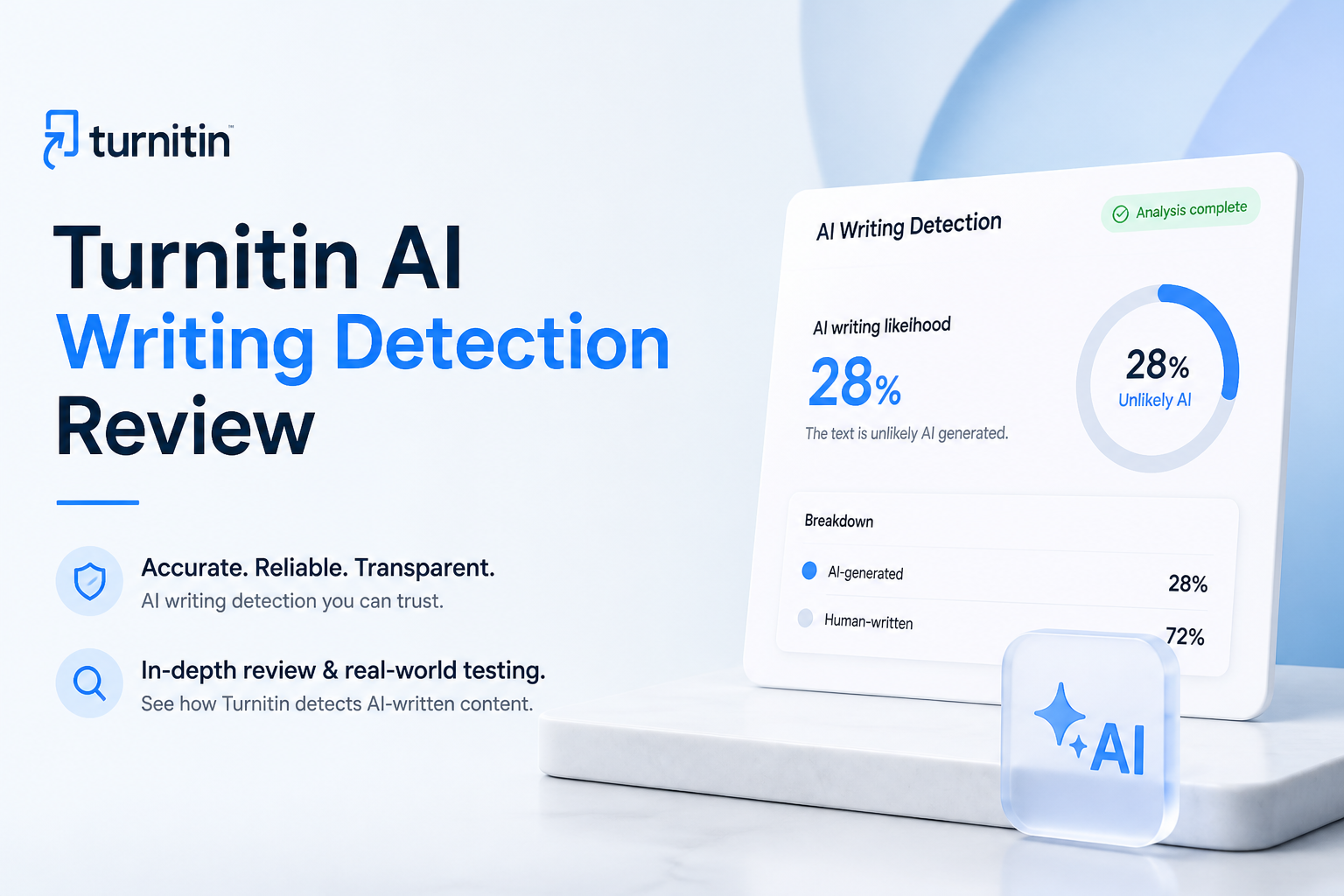
Turnitin AI Writing Detection at a Glance
4.8/10Turnitin’s detector estimates how much qualifying prose may have been generated or modified by AI. It is mainly available to instructors through institution-licensed Turnitin products.
Best forColleges already licensing Turnitin Originality that use detector results only as a starting point for human review
- Document-level AI indicator
- Highlighted qualifying passages
- English AI-paraphrase detection
- Support for four report languages
- Integration with institutional workflows
- Readable report
- Useful sentence context
- Published limitations
- No public student checker
- False-positive risk
- Opaque institutional pricing
Turnitin AI Writing Detection Features and Limitations in Detail
01 Detection Usefulness
A lead for review, not proof of authorship
5.5/10
Detection Usefulness
A lead for review, not proof of authorship
Turnitin produces a document-level AI indicator, then highlights qualifying prose that its model considers likely to be generated or altered by AI. That can narrow an instructor’s review, especially across long essays.
The problem is the meaning attached to the result. Turnitin itself says the model can misidentify human-written, AI-generated, or AI-paraphrased text. It also says the report should not be the sole basis for adverse action. That warning is sensible, though a prominent percentage can still look more conclusive than it really is.
- Highlights passages worth reviewing
- Separates the AI indicator from the similarity score
- Detects some AI-paraphrased or bypassed English text
- Fits established institutional submission workflows
- Cannot prove who wrote a document
- Results may include false positives
- Edited AI text can still complicate classification
02 Report Clarity
The strongest part of the product
7.2/10
Report Clarity
The strongest part of the product
The report is easier to interpret than a checker that returns one unexplained percentage. Instructors can inspect highlighted sections, move between pages, plus distinguish the AI result from ordinary source similarity.
Turnitin also suppresses exact scores from 1% through 19%, displaying an asterisk instead. The company says this range has a higher incidence of false positives. That design reduces overreaction to low scores, though it does not solve the larger problem of treating higher scores as proof.
- Readable passage highlighting
- AI score stays separate from plagiarism matches
- Low-range scores receive a reliability warning
- Interactive breakdown helps locate flagged prose
- A percentage still invites overconfidence
- Students may not see the same detail as instructors
- Reports need careful human interpretation
03 Student Access
A closed system controlled by institutions
2.4/10
Student Access
A closed system controlled by institutions
There is no normal public checker where a student can paste an essay, view the official result, then investigate flagged sentences before submission. Access depends on the school’s Turnitin setup, license, assignment settings, plus permissions.
This creates an awkward imbalance. An instructor may see a consequential AI score that the writer could not reproduce independently. Third-party sites claiming to offer a Turnitin check should not be assumed to use Turnitin’s actual model.
- Built into familiar university systems
- No separate instructor upload tool may be needed
- Central administration can set institutional access
- No open individual checker
- Students cannot reliably reproduce official results
- Availability depends on school licensing
04 Limits and Fairness
Too many caveats for automatic enforcement
3.9/10
Limits and Fairness
Too many caveats for automatic enforcement
The detector only processes qualifying long-form prose. Files need at least 300 words, cannot exceed 30,000 words, plus must use a supported format. Poetry, code, bullet lists, scripts, tables, or annotated bibliographies are not dependable use cases.
Supported report languages include English, Spanish, Japanese, plus Arabic. AI-paraphrase or bypass detection is limited to English. Those boundaries matter because a missing highlight may reflect document structure or language support rather than human authorship.
- Official documentation explains key file limits
- Supports four report languages
- Warns users not to rely on the score alone
- Acknowledges possible model errors
- Weak fit for short or unconventional writing
- Bypass detection is limited to English
- High-stakes use can magnify occasional errors
05 Cost Transparency
No simple plan for individual users
3.1/10
Cost Transparency
No simple plan for individual users
Turnitin does not offer a straightforward individual AI-detector subscription with a posted checkout price. AI detection is tied to qualifying institutional products plus the Originality license, leaving schools to request pricing.
For a student, editor, or independent teacher who only wants to examine a draft, the practical individual option costs $0 because it does not exist as a public Turnitin plan. Clever AI Detector is also $0, though it actually provides a public browser-based check.
- Institutions can combine detection with existing review tools
- Central licensing may suit large campuses
- No separate student payment is required when a school provides access
- No posted individual subscription price
- Quote-based institutional purchasing
- AI access may require an additional Originality license
How We Evaluated Turnitin AI Writing Detection for This Review
We reviewed Turnitin’s current AI Writing Report documentation, file requirements, access model, language support, pricing transparency, plus warnings about adverse decisions. We also examined real reports from students or instructors to see how the score affects practical academic-integrity disputes.
The scoring gave extra weight to reproducibility, writer access, report clarity, plus whether the result can safely support high-stakes action. We did not treat company accuracy claims or anonymous anecdotes as proof that every result will behave the same way.
When Turnitin AI Writing Detection Should Not Decide a Case
Avoid using the detector as the deciding evidence when the paper is short, heavily formatted, translated, full of bullet points, or outside its supported language features. It is also a poor fit when nobody has reviewed outlines, citations, drafts, revision history, or the student’s explanation.
If a report raises concern, ask the writer to explain specific passages plus show how the paper developed. A percentage alone cannot reveal who typed the words, what sources were used, or whether legitimate editing changed the prose.
Turnitin AI Writing Detection: How We Scored Its Accuracy, Access, and Fairness
| Category | Performance | Score |
|---|---|---|
| 01 Detection Usefulness | 5.5/10 | |
| 02 Report Clarity | 7.2/10 | |
| 03 Student Access | 2.4/10 | |
| 04 Limits and Fairness | 3.9/10 | |
| 05 Cost Transparency | 3.1/10 |
Turnitin AI Writing Detection vs Clever AI Detector — Head to Head
We compared public access, supported input, report detail, practical limits, plus how safely each result can be checked by the writer. Neither score should be treated as proof of authorship.
| Metric | Turnitin AI Writing Detection | Clever AI Detector |
|---|---|---|
| Public access | Institutional license required | Open browser tool, no sign-up |
| Words per check | 300 to 30,000 words | 80 to 10,000 words |
| Sentence-level signals | Highlighted qualifying prose | Color-coded sentence signals |
| Language coverage | English, Spanish, Japanese, Arabic | English |
| Writer can reproduce a check | Usually no | Yes |
| Public price | No public individual plan | $0 with unlimited checks |
| Best practical role | Instructor review inside a school workflow | Accessible first-pass screening |
| Overall score | 4.8 / 10 | 9.0 / 10 |
What to Use Instead
Use Clever AI Detector for an accessible first pass, especially when the writer needs to see the same signals as the reviewer.
01 Clever AI Detector
A free, open second opinion for English text
9.0/10
Clever AI Detector
A free, open second opinion for English text
Clever AI Detector is the more practical option for students, editors, independent instructors, plus writers. It works in a browser, requires no account, accepts 80 to 10,000 words, then provides a document probability with sentence-level signals.
Its biggest advantage is not that it settles authorship. No detector can do that. The advantage is access. Writers can run the same text themselves, inspect suspicious sentences, then compare the result with drafts or revision history. The service costs $0 with unlimited checks.
- Free with unlimited checks
- No account required
- Up to 10,000 words per scan
- Sentence-level color signals
- Accessible to writers before submission
- English text only
- Cannot prove authorship
- Results still require human review

What Students and Instructors Report About Turnitin AI Detection
A public health student said fully self-written work was flagged, leading to an academic-integrity investigation. The student relied on document history plus drafts to defend the writing process.
One researcher reported a 60% AI score on a technical paper with only 7% source similarity. Attempts to rewrite flagged language risked changing precise scientific terms.
An instructor said the AI result is reviewed only when other concerns already exist, rather than being used as standalone proof. The discussion also showed sharp disagreement over how much weight the score deserves.
Should Schools Rely on Turnitin AI Writing Detection?
Turnitin AI Writing Detection has a good report interface, though its closed access plus acknowledged error risk make it a poor judge of student authorship. Schools already paying for Turnitin may use it to identify questions for a conversation, never as automatic evidence. Students, editors, plus independent teachers should use Clever AI Detector for an open first check, then verify concerns through drafts, sources, or revision history.
Keep version history, research notes, outlines, plus dated drafts because process evidence is far more useful in an authorship dispute than a detector percentage.