How to Detect AI Generated Resume?
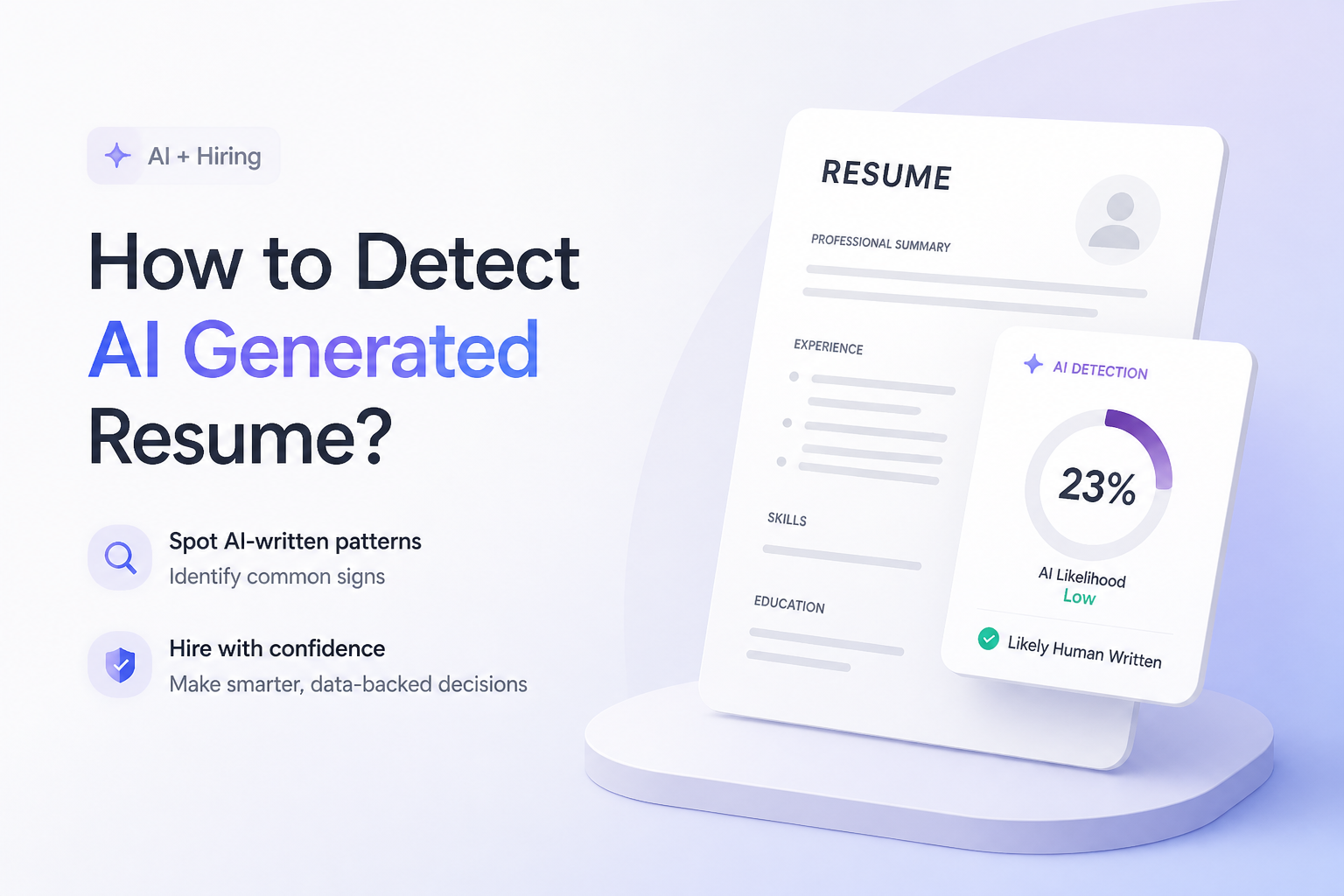
AI detection works best as a layered review, not a single score. Start with a text scan, then test suspicious passages against specific facts plus the candidate's own explanation.
Run the resume through Clever AI Detector first, then inspect highlighted passages for vague claims, repetitive phrasing, or sudden style changes. Verify the important facts plus ask job-related follow-up questions before reaching any conclusion.
Do not reject or discipline a candidate based only on an AI detector score. Human writing can trigger false positives, especially when it is formal, heavily edited, translated, or built from a template. Remove unnecessary personal data before uploading resume text to any third-party service.
Scan Resume Text for AI Signals → Clever AI Detector
Probability score with sentence-level signals · Supports English plus Spanish · Runs in a web browser
Top 5 Methods to Detect an AI-Generated Resume
01 Scan the Resume With Clever AI Detector
Fastest first check for spotting sentence-level AI signals
~2 min
Scan the Resume With Clever AI Detector
Fastest first check for spotting sentence-level AI signals
Start with a probability scan rather than guessing from tone alone. Clever AI Detector highlights sentence-level signals, which helps you locate passages worth reviewing instead of treating the whole resume as suspicious.
- Copy the resume text, leaving out the candidate's name, phone number, email, street address, plus other details the check does not need.
- Open Clever AI Detector, then paste at least 80 words into the text box.
- Select Check for AI to generate an overall probability score plus sentence-level results.
- Review the confidence indicator before interpreting the score. A result near the middle is less useful than a strong result with clear sentence signals.
- Note the highlighted lines, then verify those passages through the evidence-based methods below.
02 Audit Each Claim for Specific Details
Best for exposing polished language that lacks real substance
~5 min
Audit Each Claim for Specific Details
Best for exposing polished language that lacks real substance
AI-written resumes often sound capable while staying oddly vague. Check whether major claims contain enough context to be credible, useful, plus easy to discuss in an interview.
- Underline every achievement involving growth, savings, revenue, speed, quality, leadership, or customer impact.
- For each claim, look for a concrete scope such as team size, project length, budget, location, software, audience, or baseline.
- Mark phrases such as significantly improved, played a key role, or leveraged innovative solutions when no supporting detail follows.
- Compare the claimed outcome with the listed duties. Flag impressive results that have no visible connection to the candidate's role.
- Prepare one neutral follow-up question for each unclear claim, such as
What changed after you introduced that process?
03 Compare Style Across Resume Sections
Useful when one part sounds far more polished than the rest
~7 min
Compare Style Across Resume Sections
Useful when one part sounds far more polished than the rest
Read the resume as several small writing samples. Abrupt shifts in vocabulary, punctuation, detail, or sentence rhythm can suggest outside drafting help, though they do not reveal whether that help came from AI, a friend, or a professional writer.
- Separate the summary, experience bullets, skills, education, plus optional cover letter into distinct samples.
- Compare verb tense, punctuation, capitalization, sentence length, plus use of first-person wording across those samples.
- Circle language that appears only once, especially unusually formal terms that do not fit the rest of the document.
- Look for duplicate sentence shapes, such as repeated bullets beginning with Leveraged, Spearheaded, or Utilized.
- Record style changes as review points rather than labeling them as proof of AI use.
04 Verify Claims Against Public Sources
Stronger than style clues when dates, titles, or credentials look questionable
~10 min
Verify Claims Against Public Sources
Stronger than style clues when dates, titles, or credentials look questionable
AI can produce plausible details that do not fit a real employer, credential, or timeline. Basic source checking tests the resume's factual reliability without relying on writing style.
- Compare employer names, job titles, plus employment dates with the candidate's public professional profile when one is available.
- Confirm that named certifications exist, then check the issuing organization through its official site.
- Review whether the listed software, product, office, or initiative existed during the claimed period.
- Check for overlapping full-time roles, impossible promotion sequences, or credentials dated before the program began.
- Follow your organization's consent, privacy, plus background-check rules before contacting schools or former employers.
05 Test Key Bullets in a Structured Interview
Best final check for whether the candidate understands the claimed work
~15 min
Test Key Bullets in a Structured Interview
Best final check for whether the candidate understands the claimed work
A candidate who did the work should usually be able to explain the setting, choices, obstacles, plus outcome in their own words. Use the same neutral question pattern for every applicant to keep the process fair.
- Choose two or three important resume bullets before the interview, preferably ones tied directly to the role.
- Ask the candidate to describe the original problem, their personal responsibility, plus the first action they took.
- Request one concrete detail not shown on the resume, such as a tradeoff, failed attempt, stakeholder objection, or measurement method.
- Ask what they would change if they repeated the project today.
- Score the response against job-related criteria such as clarity, ownership, technical understanding, plus evidence. Do not score accent, nervousness, or writing style.
When an AI Detector Should Not Decide a Hiring Outcome
Do not turn a probability score into an automatic rejection rule. Formal business writing, translated text, standard resume templates, plus professional editing can resemble machine-generated prose.
A better use is triage. Let the score point toward sentences to review, then test those claims with records or consistent interview questions.
How to Review a High AI Score on a Resume
Suppose a resume scores highly because six bullets use the same polished structure. Check whether those bullets contain credible scope, whether the timeline fits, plus whether the applicant can explain the work naturally.
If the facts hold up, the writing process may not matter. If the candidate cannot explain central duties or the claims conflict with reliable records, the accuracy issue is more relevant than the AI score.
Choose the Right Method to Detect an AI-Generated Resume
Start with a quick scan, then move toward evidence that can actually be verified.
| Method | Best for | Time | Success rate |
|---|---|---|---|
| 1. Scan the Resume With Clever AI Detector TRY FIRST | Fast initial screening | ~2 min | ● 88% |
| 2. Audit Each Claim for Specific Details | Vague achievement claims | ~5 min | ● 76% |
| 3. Compare Style Across Resume Sections | Abrupt writing shifts | ~7 min | ● 64% |
| 4. Verify Claims Against Public Sources | Dates, roles, credentials | ~10 min | ● 91% |
| 5. Test Key Bullets in a Structured Interview | Validating real experience | ~15 min | ● 94% |
Which AI Resume Detection Method Should You Use?
Start with Clever AI Detector when you need a quick way to locate passages that deserve a closer look. Its result is most useful when paired with a specificity audit, factual verification, plus a structured interview.
If the decision affects someone's employment, place more weight on verifiable experience than writing patterns. A polished resume may involve AI assistance without containing false claims, while a fully human-written resume can still be inaccurate.
Remove personal details, run the text scan, document only job-related concerns, then give the candidate a fair chance to explain important claims.