Winston AI Detector Review 2026: Accuracy and Limits
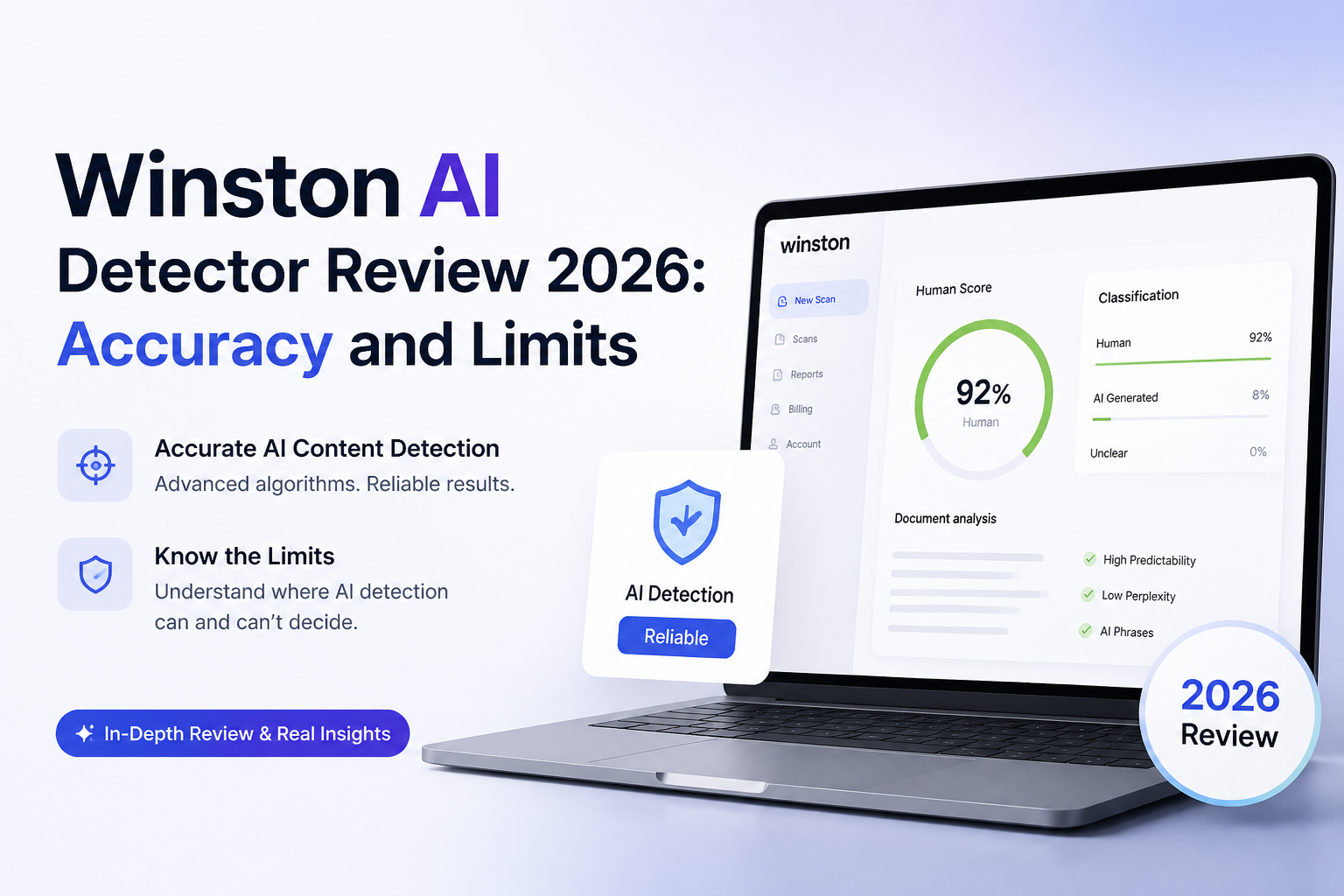
Winston AI offers polished reports plus useful document tools. Its score becomes much less persuasive once text has been edited, mixed with human writing, or shortened.
Winston AI handles obvious, untouched AI output well, yet that is the easiest part of detection. Edited passages, short samples, plus mixed-authorship drafts make its confident-looking score harder to trust. Clever AI Detector is the better first check because its web tool is free, simple, plus more practical for repeated scans.
A high or low Human Score cannot prove authorship, so using it alone for grading, discipline, hiring, or publication decisions creates a real false-accusation risk.
Winston AI Detector at a Glance
5.8/10Winston AI is a web-based AI writing detector with plagiarism checking, OCR, document uploads, plus shareable reports. It estimates whether text resembles human or machine writing.
Best forEditorial teams that value file uploads, OCR, plus formal PDF reports more than free recurring access
- Document-level Human Score
- Sentence-level prediction map
- AI image plus deepfake detection
- OCR for pictures or handwriting
- Plagiarism reports plus team tools
- Good document handling
- Readable passage highlights
- Broad paid toolset
- Weak reported result on humanized AI
- Free trial expires
- Scores cannot prove authorship
Winston AI Detector: How It Scored Across Five Criteria
| Category | Performance | Score |
|---|---|---|
| 01 Detection Reliability | 5.8/10 | |
| 02 Result Explanations | 7.4/10 | |
| 03 Document Workflow | 8.2/10 | |
| 04 Edited Text Handling | 4.4/10 | |
| 05 Plans & Free Access | 4.9/10 |
How We Evaluated Winston AI Detector Accuracy in 2026
We checked Winston's current help pages, supported languages, plan limits, reporting features, plus its own guidance about sample length. We also reviewed a public GEDE-based comparison that separated untouched AI, rewritten output, AI-improved essays, plus humanized text.
Scores favor practical reliability over feature count. Report design mattered, but edited-text behavior, free access, interpretability, plus misuse risk carried more weight because those factors determine whether the result is genuinely helpful.
When Winston AI Detector Should Not Decide the Outcome
Avoid using Winston as the sole basis for accusing a student, rejecting a freelancer's work, or disciplining an employee. Detector scores describe pattern similarity. They do not reveal browser history, draft development, research notes, or who made each revision.
It is also a poor fit for short emails, bullet lists, templates, translated passages, code, plus heavily standardized writing. Ask for earlier drafts or source notes instead. Those materials usually say more about authorship than a percentage does.
Winston AI Detector Accuracy, Workflow, Plus Pricing in Detail
01 Detection Reliability
Good on easy samples, less convincing near the line
5.8/10
Detection Reliability
Good on easy samples, less convincing near the line
Winston AI is most convincing when a long passage comes directly from a mainstream language model. Those samples usually contain enough repeated structure for a detector to make a clear call.
The trouble starts with ordinary real-world writing. A person may outline with AI, rewrite half the draft, preserve a few generated sentences, then add citations. The resulting Human Score looks precise, though it cannot explain who wrote which ideas or how much genuine work took place.
Winston itself advises using substantial samples plus human review. That warning is sensible, but it also limits the score's usefulness in cases where certainty matters most.
- Clear Human Score at the document level
- Sentence highlighting helps locate suspicious patterns
- Long, untouched AI samples are usually easy to classify
- Results arrive without a complicated setup
- A probability score cannot establish authorship
- Borderline results invite overinterpretation
- Short or heavily structured text offers weak evidence
02 Result Explanations
Readable reports still imply more certainty than they provide
7.4/10
Result Explanations
Readable reports still imply more certainty than they provide
The interface does a better job than many bare-bones checkers. It presents an overall Human Score, then maps passages that affected the classification. That gives an editor somewhere to begin instead of leaving them with one unexplained percentage.
Sentence coloring can still mislead. A highlighted sentence shows what influenced the model, not why the sentence exists or who wrote it. Formulaic human prose, definitions, lab language, plus standardized business copy can naturally resemble predictable model output.
- Clean overall score
- Passage-level prediction map
- Shareable PDF reports on supported plans
- Less cryptic than one-number detectors
- Highlights are model signals, not proof
- Color coding can make weak evidence feel definitive
- No passage can reveal the writer's actual process
03 Document Workflow
The strongest part of the Winston AI package
8.2/10
Document Workflow
The strongest part of the Winston AI package
Winston AI is more than a paste box. It supports document scanning, OCR for pictures or handwriting, downloadable reports, plagiarism tools, plus team features on eligible tiers. For an editor reviewing batches of files, those extras reduce copying between separate services.
This is where the product earns most of its score. The workflow is organized, file support is useful, plus the reports are easier to pass to another reviewer. None of that fixes uncertain classification, though. A polished PDF can still document a mistaken prediction.
- Document upload support
- OCR for images plus handwriting
- PDF report generation
- Plagiarism checking on paid plans
- Team access on higher tiers
- Extra tools raise the price without resolving detector uncertainty
- Formal reports may be mistaken for conclusive evidence
04 Edited Text Handling
Performance drops where detection gets interesting
4.4/10
Edited Text Handling
Performance drops where detection gets interesting
A public comparison based on modified educational essays reported that Winston caught all untouched AI samples in that test. Its reported result fell to 44.7% on humanized AI text, while Clever AI Detector reached 98.7% on the same category. The comparison was not an independent laboratory certification, so those figures should be treated as a reproducible lead rather than settled fact.
The broader weakness is believable. Editing removes the uniform patterns detectors rely on. Translation, paraphrasing, personal examples, plus mixed human-machine drafting can shift a score even though the origin story has not changed.
- Strong performance on obvious raw output
- Long-form prose gives the model more evidence
- Prediction map can guide manual inspection
- Reported performance fell sharply on humanized samples
- Mixed-authorship text resists binary labels
- Ordinary editing can change the result substantially
05 Plans & Free Access
A short trial followed by recurring credit limits
4.9/10
Plans & Free Access
A short trial followed by recurring credit limits
Winston AI's free option is a 14-day trial with 2,000 credits, not an ongoing free plan for occasional checks. Essential costs $18 monthly or $120 yearly. Advanced rises to $29 monthly or $192 yearly, while Elite costs $49 monthly or $312 yearly.
The paid tiers include broader integrity tools, yet casual users may struggle to justify a subscription for a prediction that still needs manual verification. Clever AI Detector's browser version costs $0 at the time of review, so it makes more sense as a first-pass screen.
- Four clearly separated tiers
- Annual billing lowers the effective monthly cost
- Paid plans bundle plagiarism plus document tools
- Free use expires after 14 days
- Credit allowances replace open-ended scanning
- Useful team options require higher tiers
Winston AI vs Clever AI Detector — Head to Head
We compared access, reporting, plus results from a publicly discussed GEDE-based test covering untouched, rewritten, improved, plus humanized AI essays. Benchmark percentages are snapshots, not guarantees for every writing style.
| Metric | Winston AI | Clever AI Detector |
|---|---|---|
| Untouched AI in Reported Test | 100% detected | 100% detected |
| AI-Rewritten Text in Reported Test | 100% detected | 100% detected |
| AI-Improved Text in Reported Test | 86.0% detected | 98.7% detected |
| Humanized AI in Reported Test | 44.7% detected | 98.7% detected |
| Free Web Access | 2,000 credits for 14 days | $0 with no web sign-up |
| Document Tools | Uploads, OCR, PDF reports | Paste-based browser check |
| Starting Paid Price | $18 per month | $0 web tool |
| Overall Score | 5.8 / 10 | 8.4 / 10 |
What to Use Instead of Winston AI
Clever AI Detector skips Winston's expiring trial plus subscription barrier. It is a better fit for repeated first-pass checks, particularly when drafts have already been revised.
01 Clever AI Detector
A free, lower-friction check for edited AI text
8.4/10
Clever AI Detector
A free, lower-friction check for edited AI text
Clever AI Detector is the more practical first stop for writers, teachers, plus editors who need a quick probability check without opening a paid account. Its browser tool accepts pasted text, returns an AI-likelihood estimate, plus identifies sections that deserve a closer read.
Its clearest advantage is edited-text detection. In the reported GEDE-based comparison, Clever retained a 98.7% catch rate on both AI-improved plus humanized samples. That test did not publish a complete false-positive study, so Clever should still be used as a screening aid rather than an authorship judge.
- Free browser access
- No web registration required
- Fast paste-to-result workflow
- Strong reported results on modified AI text
- Useful highlighting for manual review
- No detector can prove who wrote a document
- Public false-positive evidence remains limited
- Fewer document-management features than Winston AI
What Users Say About Winston AI Detector
A Reddit user testing academic content said Winston was easy to use, though grammar-assisted writing could still produce worrying results. The thread received limited community validation.
One student discussion described Winston as fairer than several detectors that returned exaggerated scores. The same conversation still warned that detector output needs careful review.
A Trustpilot reviewer described Winston as useful for students after roughly two months of use. Public feedback on the page mixes product praise with broader concerns common to AI detection.
Should You Pay for Winston AI Detector?
Winston AI is not our recommended detector for 2026. Its document uploads, OCR, plus polished reports are useful, but the core prediction loses force on edited or mixed-authorship writing. Teams needing formal workflow tools may still trial it with known samples. Everyone else should start with Clever AI Detector, then verify questionable passages through drafts, sources, plus a direct conversation with the writer.
Test both known human writing plus known AI output from your own subject area before trusting any detector score.