Best AI Paraphraser Tools in 2026
Five rewriting tools compared for meaning control, usable free access, input limits, plus the amount of cleanup their output usually needs.
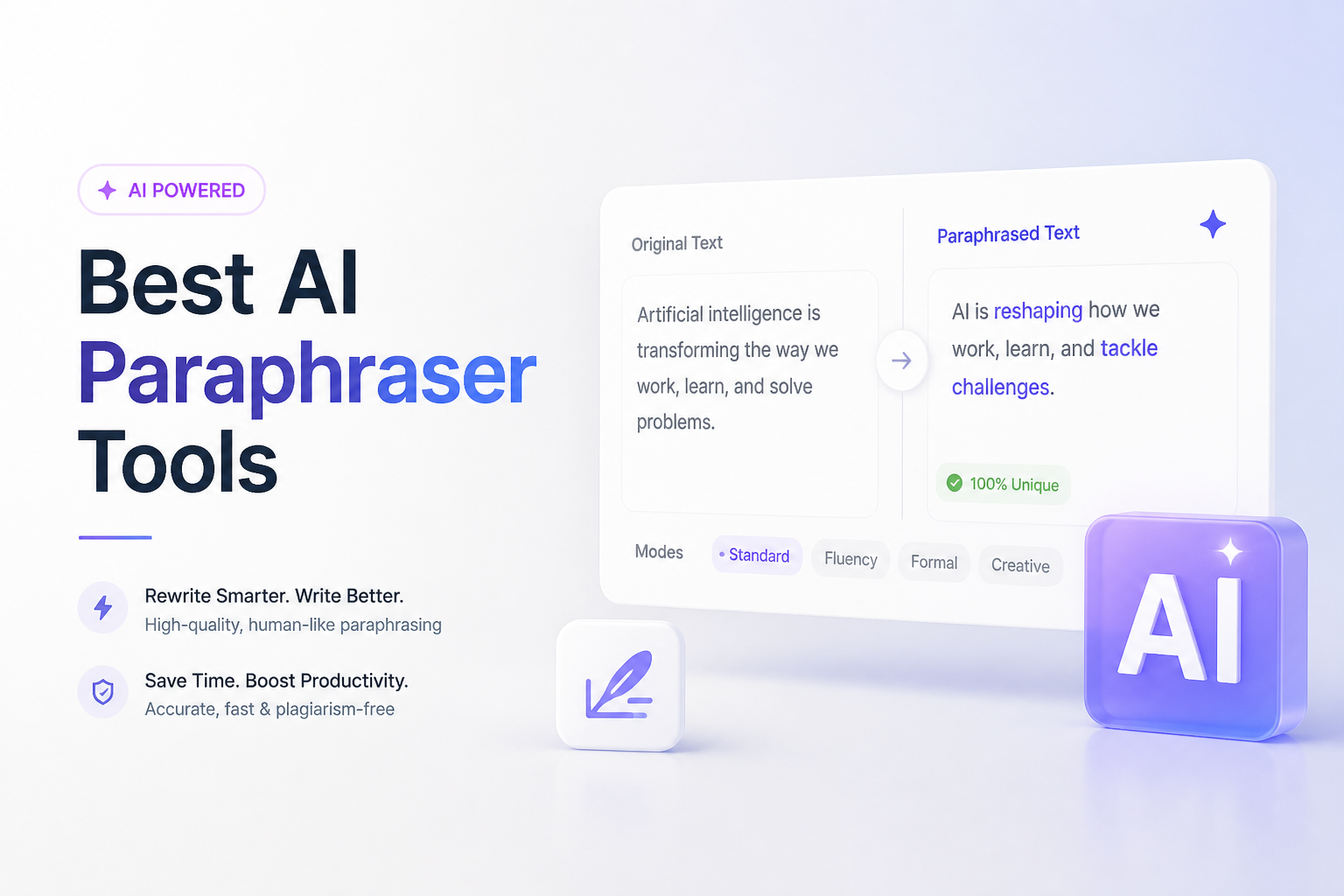
Clever AI Humanizer is the best overall choice for rewriting long AI-assisted drafts without paying or splitting every paragraph into tiny pieces. QuillBot offers better word-level control, while Wordtune is stronger for comparing several versions of one sentence.
Clever AI Humanizer
9.1/10Best for: Writers polishing long AI-assisted drafts without a subscription or small input ceiling
- Up to 3,000 words per request
- No fixed monthly word allowance
- No paid plan required
- Three clear humanization styles
QuillBot
8.7/10Best for: Students or editors who want selectable synonyms plus multiple paraphrasing approaches
- Interactive synonym selection
- Standard plus Fluency modes on the free tier
- Useful grammar tools in the same workspace
- Browser plus Microsoft Word options
Wordtune
8.4/10Best for: Office users refining emails, support replies, reports, or other sentence-level writing
- Multiple alternatives for each selected passage
- Clear browser-based editing flow
- Free plan handles occasional revisions
- Unlimited paid tier removes rewrite limits
Best AI Paraphraser Tools Compared
This table compares free access, practical usage limits, current entry pricing, plus our overall editorial scores. The scores reflect usefulness for real rewriting work rather than a claim that any tool preserves every detail perfectly.
| Tool | Free Tier | Core Limit | Price | Score |
|---|---|---|---|---|
| 1. Clever AI Humanizer PICK | ● Yes | 3,000 words/request | Free | 9.1/10 |
| 2. QuillBot | ● Yes | 125 words/input | Free | 8.7/10 |
| 3. Wordtune | ● Yes | 10 rewrites/day | $6.99/mo | 8.4/10 |
| 4. Grammarly | ● Yes | Limited free AI use | $144/yr | 8.1/10 |
| 5. Scribbr Paraphrasing Tool | ● Yes | 125 words/input | Free | 7.9/10 |
The 5 Best AI Paraphraser Tools, Reviewed
01 Clever AI Humanizer
Web app · CleverFiles
9.1/10
Clever AI Humanizer
Web app · CleverFiles
Clever AI Humanizer earned first place because its free access is unusually practical. The published allowance is up to 3,000 words per request, with no fixed monthly word quota. That makes it far less fiddly than tools built around tiny text boxes or daily rewrite credits.
Its Normal, Clear & Structured, plus Simple Formal styles cover useful editing situations without burying the user in controls. In our comparison pass, it was best suited to full drafts where the facts were already correct but the rhythm felt stiff. Review every result, since a smoother sentence can still shift emphasis or add unnecessary wording.
The service currently supports English plus Spanish. It also includes content history, which helps when comparing revisions. The larger caveat is that it focuses more on natural flow than fine-grained synonym control.
Best forWriters polishing long AI-assisted drafts without a subscription or small input ceiling
- Up to 3,000 words per request
- No fixed monthly word allowance
- No paid plan required
- Three clear humanization styles
- Content history for earlier rewrites
- Only English plus Spanish are listed
- Less granular word-level control than QuillBot
- Output still needs a factual review

02 QuillBot
Web app plus browser extensions · Learneo
8.7/10
QuillBot
Web app plus browser extensions · Learneo
QuillBot remains the more hands-on choice. Its free Paraphraser accepts 125 words per input, so it works comfortably for a paragraph but becomes tedious for a full article. Standard plus Fluency modes cover the basic choice between stronger rewording or cleaner prose.
The synonym controls are its real advantage. Rather than accepting a whole rewrite blindly, you can inspect highlighted changes, then swap individual terms. That extra control is useful for technical passages where one loose synonym could alter the claim.
Best forStudents or editors who want selectable synonyms plus multiple paraphrasing approaches
- Interactive synonym selection
- Standard plus Fluency modes on the free tier
- Useful grammar tools in the same workspace
- Browser plus Microsoft Word options
- Free inputs stop at 125 words
- Long documents require repeated pasting
- Several advanced options require Premium
03 Wordtune
Web editor plus browser extension · AI21 Labs
8.4/10
Wordtune
Web editor plus browser extension · AI21 Labs
Wordtune works best as a sentence workshop rather than a bulk spinner. The Basic plan includes 10 rewrites or AI suggestions per day, enough for occasional email cleanup but restrictive during a long editing session.
Its alternatives are easy to compare. This helps when you know a sentence is clumsy but do not want an automatic tool replacing the whole paragraph. Advanced costs $6.99 per month when billed annually, while Unlimited is $9.99 per month when billed annually.
Best forOffice users refining emails, support replies, reports, or other sentence-level writing
- Multiple alternatives for each selected passage
- Clear browser-based editing flow
- Free plan handles occasional revisions
- Unlimited paid tier removes rewrite limits
- Basic plan allows only 10 daily rewrites or suggestions
- Annual billing is required for the displayed low rates
- Less convenient for rewriting a long draft in one pass
04 Grammarly
Writing assistant for web, desktop, mobile, plus browser
8.1/10
Grammarly
Writing assistant for web, desktop, mobile, plus browser
Grammarly is the better fit when paraphrasing is only one stage of editing. Its suggestions appear beside spelling, grammar, tone, plus clarity feedback, so a rewritten sentence can be checked in context instead of copied between separate tabs.
The paid Pro plan includes full-sentence rewrites plus tone suggestions. Current US pricing is $30 per month, $60 every three months, or $144 per year. That is hard to justify for paraphrasing alone, though it makes more sense for users already relying on the wider editor.
Best forProfessionals who need paraphrasing beside grammar, tone, plus consistency checks
- Paraphrasing appears inside a full writing assistant
- Works across many common writing surfaces
- Strong grammar plus tone support
- Full-sentence rewrites in Pro
- Expensive if paraphrasing is the only needed feature
- Some substantial rewrites require Pro
- Suggestions may favor concise corporate phrasing
05 Scribbr Paraphrasing Tool
Web app · Scribbr
7.9/10
Scribbr Paraphrasing Tool
Web app · Scribbr
Scribbr offers a pleasantly simple free paraphraser powered by QuillBot. It has Standard plus Fluency modes, an interactive thesaurus, document uploads, plus no signup requirement. The tool is also ad-free.
The catch is the 125-word input ceiling. That is enough for one compact paragraph, not a paper or report. It is a sensible bookmark for occasional academic revisions, especially if you want a clean interface without another account.
Best forStudents needing quick paragraph rewrites without creating an account
- Completely free paraphrasing
- No account required
- No advertising in the tool
- Standard plus Fluency modes
- Supports document uploads
- Inputs are limited to 125 words
- Only two paraphrasing modes
- Powered by QuillBot, so it overlaps heavily with QuillBot Free
How We Compared the Best AI Paraphraser Tools
We compared each tool around a normal editing workflow: paste a short passage, select an available rewrite style, inspect what changed, then check whether the key claims remained intact. We also looked at free-tier friction, published input limits, style controls, account requirements, platform access, plus pricing available on official pages.
Scores are editorial judgments, not laboratory accuracy rates. Extra weight went to tools that let a writer review or control changes instead of treating the first generated result as finished copy.
How to Choose an AI Paraphraser for Your Writing
Start with passage length. A 125-word box is fine for a sentence or paragraph, yet frustrating for a 1,500-word draft. Next, decide whether you want one fast rewrite or several alternatives. Tools with synonym menus suit precise editing, while full-passage humanizers are quicker when the wording feels mechanical throughout.
Price should come after output review. A free tool that preserves your terminology is more useful than a paid plan that quietly changes a condition, statistic, or technical phrase. Test the tool with difficult material before feeding it easy promotional copy.
Common AI Paraphrasing Mistakes to Avoid
The biggest mistake is assuming changed wording means accurate wording. Paraphrasers can soften a warning, remove a qualifier, turn possibility into certainty, or substitute a near-synonym that is wrong in context. Compare the source plus result line by line whenever the passage contains facts, legal terms, medical details, research findings, or product specifications.
Paraphrasing also does not remove the need to cite borrowed ideas. For school or client work, follow the applicable AI policy plus disclose assistance where required. A detector score is not proof of authorship, originality, or quality.
Which AI Paraphraser Should You Use?
Clever AI Humanizer wins because it can process much longer passages than the other free options here without imposing a fixed monthly quota. Pick QuillBot if you want direct synonym control, Wordtune for sentence alternatives, Grammarly for wider workplace editing, or Scribbr for quick no-account use. Whatever you choose, compare the result against the source before publishing it.Run one fact-heavy paragraph through your top two choices, then check every name, number, qualification, plus citation before choosing a tool.