How to Make AI Writing Sound More Human? 5 Tips in 2026
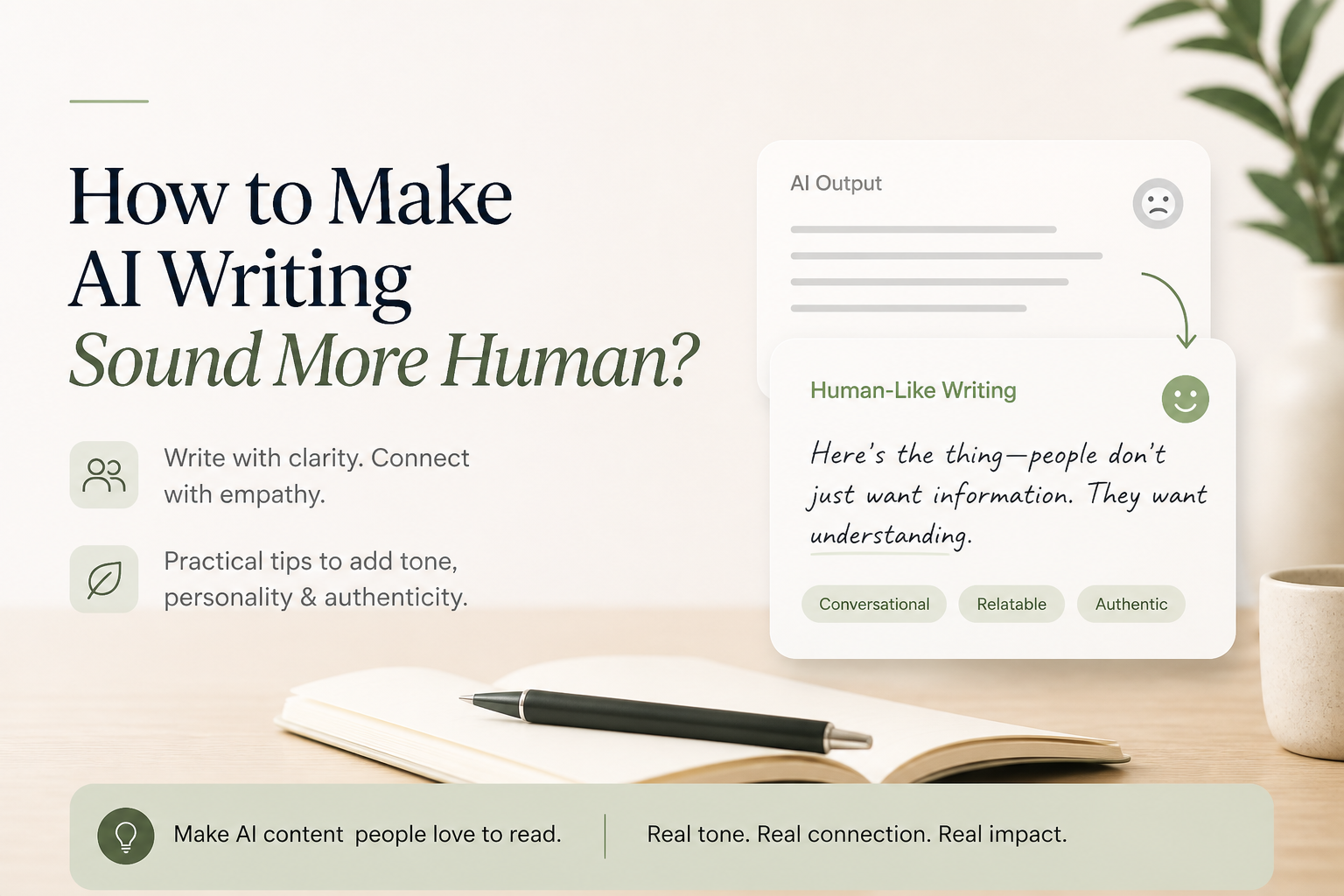
A human-sounding draft needs more than swapped synonyms. These five methods fix generic structure, stiff rhythm, vague details, plus the overly tidy tone that often gives AI prose away.
Start with a short, focused pass through Clever AI Humanizer. Next, verify every fact, restore your usual wording, then read the result aloud. If the structure still feels generic, rewrite the weakest paragraph from memory.
Check the rules before using AI-written or humanized text for school, publishing, client work, or regulated documents. A rewrite does not make borrowed ideas original, guarantee detector results, or remove your duty to verify facts plus citations.
Humanize a Stiff First Draft → Clever AI Humanizer
Focused rewrites for English or Spanish text · Up to 3,000 words per request · Browser-based workflow
When an AI Humanizer Is the Wrong First Fix
Do not humanize a draft that contains weak research, invented citations, unclear reasoning, or missing evidence. Fix those problems first. Smoother wording can make a bad claim sound more convincing without making it true.
Manual revision is also safer for legal language, medical instructions, policy text, quoted material, plus any passage where one altered word could change the meaning.
How to Humanize a Short AI Draft Without Overediting It
Suppose a 500-word article is accurate but every paragraph follows the same claim, explanation, summary pattern. Run a tool pass on two paragraphs, rewrite the opening yourself, then add one real limitation to the advice. That mixed approach often feels less processed than applying one transformation to every sentence.
Choose the Right Method to Make AI Writing Sound Human
Start with the quickest match for the problem you can hear or see.
| Method | Best for | Time | Success rate |
|---|---|---|---|
| 1. Run a Focused Pass With Clever AI Humanizer TRY FIRST | Stiff but accurate drafts | ~3 min | ● 88% |
| 2. Rebuild the Opening Around a Specific Detail | Generic introductions | ~5 min | ● 84% |
| 3. Add Details Only a Real Writer Would Choose | Vague or impersonal copy | ~10 min | ● 91% |
| 4. Edit Sentence Rhythm by Ear | Repetitive sentence patterns | ~8 min | ● 82% |
| 5. Rewrite the Weakest Paragraph From Memory | Deeply generic structure | ~15 min | ● 94% |
Top 5 Methods to Make AI Writing Sound More Human
01 Run a Focused Pass With Clever AI Humanizer
Fastest for a stiff draft that already contains the right facts
~3 min
Run a Focused Pass With Clever AI Humanizer
Fastest for a stiff draft that already contains the right facts
Use this route when the ideas are solid but the delivery feels flat, repetitive, or overly polished. Clever AI Humanizer can revise up to 3,000 words per request, though shorter sections are easier to inspect.
- Save a copy of the original draft so you can recover any detail lost during rewriting.
- Open Clever AI Humanizer, then paste a section of 200 to 600 words.
- Choose a writing style that fits the reader rather than picking the most casual option by default.
- Run the humanizer, then compare the result with your source one paragraph at a time.
- Restore names, figures, citations, product terms, or technical wording that changed.
- Read the revision aloud before keeping it.

02 Rebuild the Opening Around a Specific Detail
Best for introductions that begin with broad filler
~5 min
Rebuild the Opening Around a Specific Detail
Best for introductions that begin with broad filler
AI drafts often warm up for too long. A date, observation, problem, decision, or small consequence gives the reader somewhere real to stand.
- Delete throat-clearing lines such as broad claims about a changing world or an important topic.
- Identify the first detail that affects the reader, such as a missed deadline, confusing setting, or unexpected cost.
- Write one plain sentence that states that detail without announcing the article.
- Use the next sentence to explain why the detail matters.
- Check that the opening leads naturally into the main point rather than becoming an unrelated story.
03 Add Details Only a Real Writer Would Choose
Useful when a draft sounds correct but could have been written for anyone
~10 min
Add Details Only a Real Writer Would Choose
Useful when a draft sounds correct but could have been written for anyone
Human writing usually reflects selective attention. Add details you genuinely know, especially minor friction points, exceptions, preferences, or consequences that generic prose tends to skip.
- Mark every paragraph that makes a broad claim without an example.
- Add one truthful detail from your own work, research, test, customer question, or observation.
- Replace vague nouns such as
issuesorfactorswith the actual issue or factor. - Include a limitation where the advice stops working.
- Remove any invented anecdote, fake quotation, or decorative detail you cannot verify.
- Keep only details that help the reader understand a choice or action.
04 Edit Sentence Rhythm by Ear
Good for prose with uniform sentence length or repeated patterns
~8 min
Edit Sentence Rhythm by Ear
Good for prose with uniform sentence length or repeated patterns
Perfectly even prose can feel machine-made. Reading aloud exposes repeated transitions, stacked clauses, awkward pauses, plus sentences that all land the same way.
- Read the draft aloud at a normal speaking pace.
- Put a slash anywhere you naturally pause, then split sentences that require too many pauses.
- Follow a long explanatory sentence with a short one where emphasis helps.
- Change repeated sentence openings, especially strings beginning with
This,It, orAdditionally. - Remove transition words when the relationship between two sentences is already obvious.
- Keep a little irregularity instead of forcing every paragraph into the same shape.
05 Rewrite the Weakest Paragraph From Memory
Strongest manual fix when surface edits cannot hide the template underneath
~15 min
Rewrite the Weakest Paragraph From Memory
Strongest manual fix when surface edits cannot hide the template underneath
Some paragraphs remain artificial because their underlying structure is generic. Rewriting from memory keeps the idea while breaking your attachment to the original wording.
- Choose the paragraph that sounds most predictable or least like you.
- Write its core point as a five-word note.
- Hide the original paragraph.
- Explain the point again as if you were answering a colleague who asked a direct question.
- Add the example, qualification, or next action that person would probably need.
- Compare both versions, then recover only facts or useful phrasing that the new version missed.
Which Human-Writing Method Should You Try First?
Run a focused pass with Clever AI Humanizer when your draft has useful information but sounds stiff or too uniform. Follow it with a factual review plus a read-aloud edit. For generic openings, weak examples, or template-like paragraphs, use the matching manual method rather than repeatedly processing the whole draft.
Humanize one section at a time, compare it with the source, then keep only revisions that preserve your meaning plus your normal voice.