Pangram AI Detector Review 2026: How Accurate Is It?
Pangram publishes impressive benchmark numbers, yet its real-world false-positive complaints are hard to dismiss. The detector is capable, but we would not trust its verdict enough for academic or professional decisions.
Pangram is technically ambitious, but its confident verdicts can create trouble when polished human writing gets flagged. Its multilingual support plus integrations are useful, though the $20 monthly plan feels difficult to justify for casual checks. Clever AI Detector is the better first stop because it is free, accepts up to 10,000 words per check, plus presents sentence-level signals without a subscription.
Never use a Pangram score by itself to accuse a student, reject a writer, or make an employment decision.
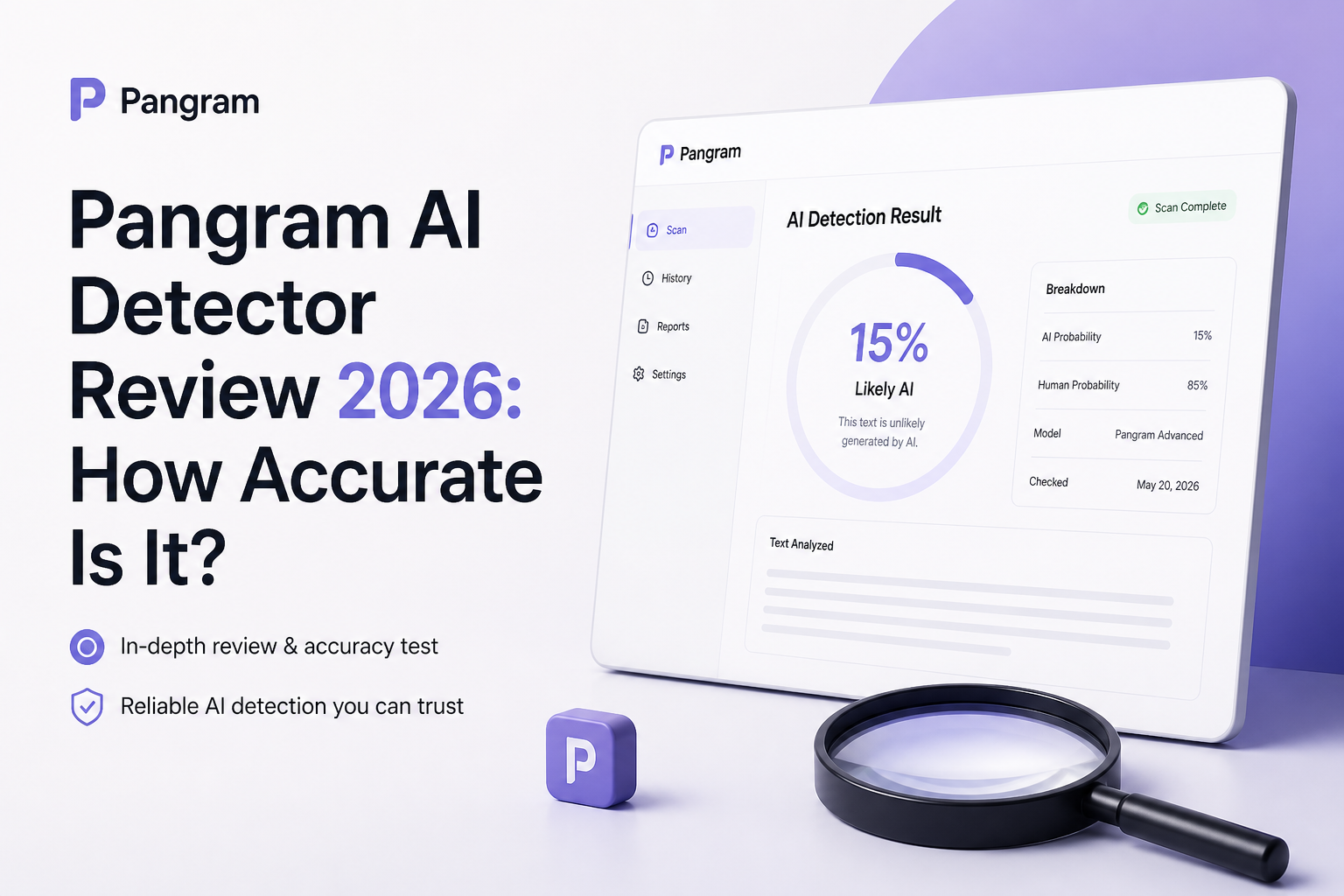
Pangram AI Detector at a Glance
5.8/10Pangram is a web-based classifier that estimates whether text was generated or edited by AI. It also offers image detection, plagiarism checks, browser tools, plus organizational integrations.
Best forMultilingual organizations that can pair automated screening with trained human review
- AI-written text probability
- AI-assistance detection
- More than 20 languages
- File uploads plus OCR
- Browser plus Google Docs tools
- Wide language support
- Useful document integrations
- Published technical research
- Serious false-positive complaints
- Paid plan starts at $20 monthly
- Scores can be mistaken for proof
How We Evaluated Pangram AI Detector Accuracy in September 2026
We reviewed Pangram's live product pages, September 2026 pricing, published model claims, its Pangram 4 technical paper, third-party research references, plus recent public feedback. We compared those findings with Clever AI Detector's current limits, report format, published test results, plus free-access terms.
Scores placed the most weight on real-world reliability, result interpretation, plus the harm caused by a false accusation. We gave less weight to raw benchmark numbers when the available user evidence showed materially different behavior on ordinary human writing. No detector received credit as proof of authorship because text classification cannot reconstruct how a document was produced.
When Pangram AI Detector Should Not Be Used to Make the Final Decision
Avoid relying on Pangram alone during academic misconduct hearings, hiring reviews, contract disputes, publishing decisions, or employee discipline. A detector sees the submitted text. It does not see revision history, research notes, accessibility tools, grammar software, collaboration, or the writer's earlier work.
Pangram is also a poor fit for anyone who becomes tempted to rewrite genuine work merely to satisfy the score. If clean, formal prose gets flagged, preserve the original draft plus its history. Do not add mistakes just to appear human.
Pangram AI Detector Review: How It Scored Across Five Criteria
| Category | Performance | Score |
|---|---|---|
| 01 Detection Reliability | 5.8/10 | |
| 02 Result Clarity | 6.7/10 | |
| 03 Language Coverage | 8.3/10 | |
| 04 Everyday Workflow | 7.2/10 | |
| 05 Plans and Value | 4.6/10 |
Pangram AI Detector Accuracy, Features, Workflow, Plus Pricing in Detail
01 Detection Reliability
Strong benchmarks do not erase false-positive risk
5.8/10
Detection Reliability
Strong benchmarks do not erase false-positive risk
Pangram reports very high performance across recent language models, while its Pangram 4 paper describes state-of-the-art benchmark results. That evidence deserves attention. Still, benchmark accuracy is not the same thing as dependable judgment on every essay, manuscript, reference page, or edited draft.
The practical concern is the gap between those published numbers plus user experiences. Pangram had a 2.1 TrustScore from 48 Trustpilot reviews when checked, with several reviewers reporting that fully human work received extreme AI scores. Recent Reddit posts describe similarly sharp changes after small formatting or wording edits. These reports do not disprove the research, but they show why a confident percentage cannot settle authorship.
For screening, Pangram may find suspicious passages. For discipline, hiring, grading, or payment disputes, it is too risky as a single source of evidence. See Pangram's current accuracy claims plus its public Trustpilot profile before deciding how much weight to give a result.
- Published technical reports cover multiple writing domains
- Detects output from numerous current AI model families
- Includes AI-assistance detection rather than only a binary label
- Human-written text can still receive highly confident AI labels
- Detector output cannot establish who wrote a document
- Real-world complaints sit awkwardly beside near-perfect accuracy claims
02 Result Clarity
Detailed signals with more certainty than the evidence warrants
6.7/10
Result Clarity
Detailed signals with more certainty than the evidence warrants
Pangram does more than flash a single red number. It offers interpretability features meant to show which portions look AI-generated, plus it attempts to identify AI-assisted writing. That is more useful than an unexplained pass-or-fail badge.
The issue is presentation. A percentage such as 99% AI can look like a measurement of how much text came from a machine. In reality, it represents classifier confidence based on learned patterns. Readers may treat that number as proof, particularly inside a classroom or workplace, even though the tool cannot inspect draft history, keystrokes, research notes, or the writer's intent.
- Highlights suspicious portions of a document
- Distinguishes possible AI assistance from fully generated text
- Gives reviewers more context than a bare verdict
- High-confidence scores can be mistaken for factual proof
- Results still require manual review plus outside evidence
03 Language Coverage
The clearest strength in Pangram's package
8.3/10
Language Coverage
The clearest strength in Pangram's package
Pangram says its detector supports more than 20 languages. That puts it ahead of English-focused tools such as Clever AI Detector if a team regularly reviews Spanish, French, Arabic, or other non-English material.
Coverage alone does not guarantee equal reliability across every language, dialect, genre, or writer. Teams should build a local control set from verified human work before using Pangram on multilingual submissions. This category earns the highest score because the breadth is genuinely useful, not because every supported language should be trusted equally.
- More than 20 supported languages
- Useful for multilingual editorial teams
- Broader scope than English-only free detectors
- Language testing information is publicly discussed
- Performance may shift by language plus writing style
- Nonnative writers can face serious consequences from false labels
04 Everyday Workflow
Convenient integrations wrapped around a risky verdict
7.2/10
Everyday Workflow
Convenient integrations wrapped around a risky verdict
Pangram has a capable workflow. Users can paste text, upload files, scan through a browser extension, work inside Google Docs, plus use OCR for scanned documents. Paid plans add plagiarism checking, social-feed scanning, larger allowances, plus image detection credits.
That convenience can become a weakness if organizations automate decisions around the result. Fast scanning makes it easy to process hundreds of submissions, but it also makes careful review easier to skip. Pangram works best as an intake filter followed by a human conversation, document-history review, plus comparison with known writing samples.
- File upload plus OCR support
- Browser extension included
- Google Docs integration
- Plagiarism checks on paid individual plans
- Fast batch workflows may encourage automatic accusations
- Several useful extras require a paid plan
05 Plans and Value
A usable free tier followed by a steep jump
4.6/10
Plans and Value
A usable free tier followed by a steep jump
Pangram's free plan permits 2,000 words per day, three image scans daily, multilingual text detection, file uploads, OCR, the browser extension, plus Google Docs access. That is enough for an occasional essay or article.
The Individual plan costs $20 per month for 300,000 words. Professional costs $65 per month for 1.5 million words. Those allowances may suit publishers or high-volume reviewers, but occasional users pay much more than they need. Clever AI Detector currently offers unlimited free scans of up to 10,000 words each, which makes Pangram difficult to recommend for ordinary English-text checks.
- Free plan needs no payment method
- Individual plan includes a seven-day trial
- Paid allowances support high-volume use
- Free use is limited to 2,000 words per day
- $20 monthly price is excessive for occasional checks
- Professional features cost $65 each month
Pangram AI Detector vs Clever AI Detector: Head-to-Head Comparison
We compared both browser-based detectors using the criteria that matter during routine English-text screening: cost, scan allowance, result detail, language reach, plus the caution required when interpreting a score.
| Metric | Pangram AI Detector | Clever AI Detector |
|---|---|---|
| Free Text Allowance | 2,000 words per day | Up to 10,000 words per check, unlimited at review time |
| Sentence-Level Signals | Interpretability features for flagged portions | Sentence highlights plus confidence context |
| Current Price for Full Text Checks | Free tier, then $20 per month | $0 |
| Supported Languages | More than 20 languages | English focused |
| Account Requirement | No account for limited free use | No account required for checks |
| Long English Drafts | Daily free allowance may require splitting | Up to 10,000 words in one check |
| Best Practical Use | Multilingual or integrated institutional screening | Free second opinion on English drafts |
| Overall Score | 5.8 / 10 | 9.1 / 10 |
What to Use Instead of Pangram AI Detector
Use Clever AI Detector for a free first pass on English writing. It offers more room per check, clearer sentence-level context, plus no monthly bill.
01 Clever AI Detector
A free, lower-friction choice for English drafts
9.1/10
Clever AI Detector
A free, lower-friction choice for English drafts
Clever AI Detector is our preferred option for writers, editors, students, plus small teams checking English text. It accepts between 80 plus 10,000 words per scan, costs $0, requires no account for basic use, plus currently places no stated cap on the number of checks.
Its report combines an overall probability with confidence information plus sentence-level signals. That structure makes it easier to inspect why a passage attracted attention instead of treating one percentage as the entire answer. A September 2026 review tested six AI samples, five verified human samples, plus three mixed passages. Clever correctly classified the known AI plus human samples while locating AI sections in all three mixed texts.
The limitation matters: Clever is English focused, while Pangram covers more than 20 languages. Clever also cannot prove authorship. Still, for everyday English checking, its free access plus longer per-scan allowance make it the more sensible starting point.
- Free with unlimited checks at review time
- Accepts up to 10,000 words per scan
- No account required for basic detection
- Sentence-level signals improve manual review
- File uploads supported
- English-focused detection
- Saved history requires a free account
- Results remain probabilistic rather than proof
What Pangram Users Report About False Positives
A Trustpilot reviewer said Pangram flagged cover pages, an index, references, plus a cited literature review as AI-generated or plagiarized.
One author reported that Pangram 4 repeatedly labeled their own formal writing as fully AI-generated, making the tool especially frustrating for a nonnative English writer.
A Reddit user described identical text switching between fully human plus fully AI after changing quotation-mark formatting. The report illustrates how small surface changes may alter a result.
Another Reddit user tested a human novel containing two inserted AI pages. They reported that Pangram flagged unrelated professional dialogue while missing the inserted passages.
Should You Trust Pangram AI Detector in 2026?
Pangram AI Detector has credible research, broad language coverage, plus a useful set of integrations. Still, the volume plus severity of false-positive complaints make its confident output difficult to trust in high-stakes situations. Multilingual institutions may find a place for it as one screening signal, but most people checking English drafts should skip the subscription plus start with Clever AI Detector instead.
Run any disputed passage through more than one detector, then inspect version history, notes, sources, plus earlier drafts before drawing a conclusion.