Paperpal AI Detector Review 2026: How Accurate Is It?
Paperpal gives academic writers a polished detector report, yet its score is harder to trust than the interface suggests. Tight free limits plus a costly upgrade weaken the deal further.
Paperpal AI Detector is easy to read, but its accuracy remains insufficiently validated for serious authorship decisions. The free plan stops at five daily scans of 1,200 words each. Clever AI Detector is the better pick because it checks up to 10,000 words for $0, gives sentence-level signals, plus requires no account for basic use.
A Paperpal percentage cannot establish who wrote a document, so never use it alone to accuse a student, reject a manuscript, or challenge an author.
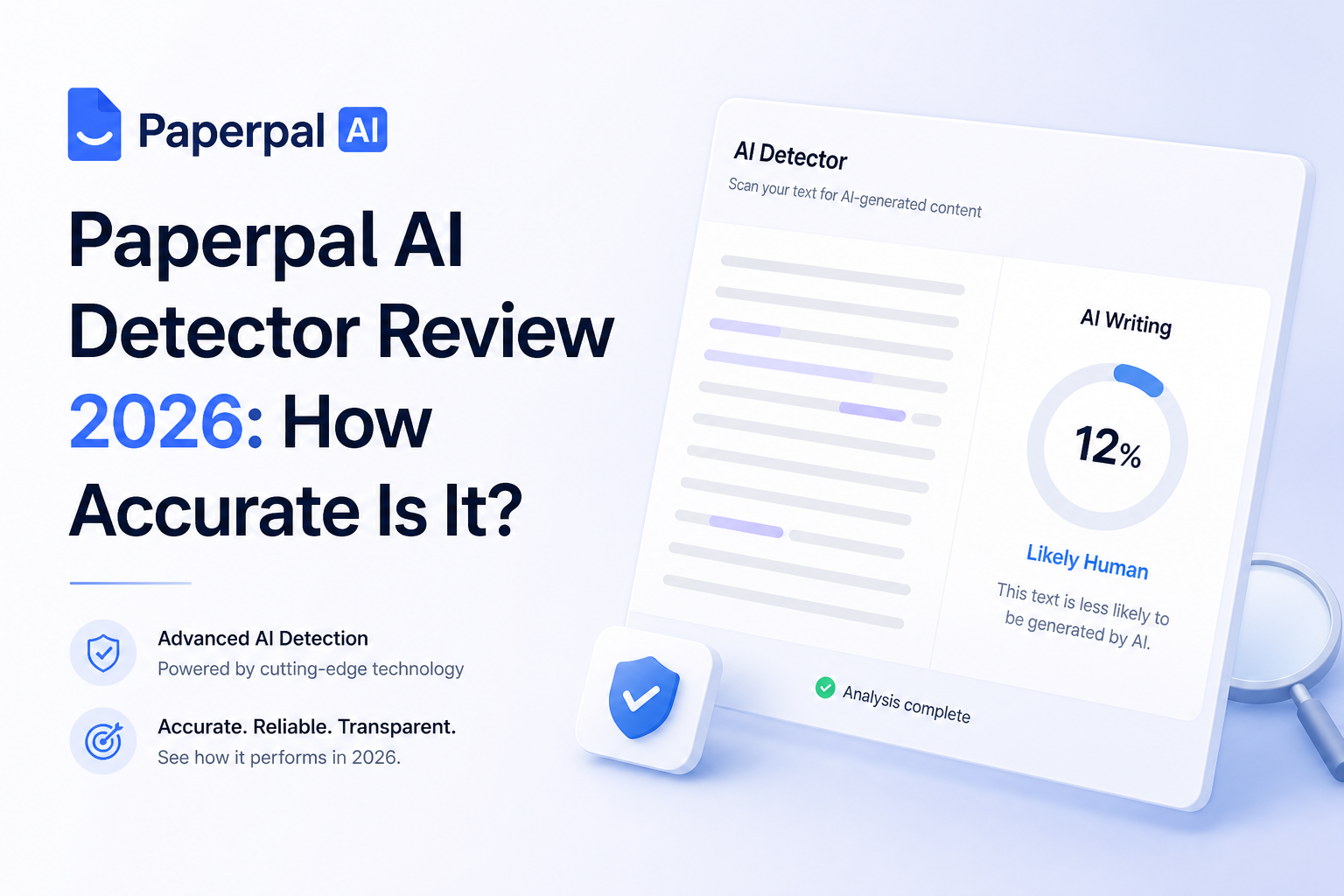
Paperpal AI Detector at a Glance
6.1/10Paperpal AI Detector is an online checker made for essays, research papers, plus other academic writing. It estimates AI involvement, then highlights passages for review.
Best forExisting Paperpal subscribers who want a convenient secondary signal inside their academic editing workflow
- Three-band human, AI, plus blended classification
- Document-wide AI involvement score
- Sentence-level indicators
- File uploads
- Integration with Paperpal's academic writing suite
- Clear sentence highlights
- Academic-focused workflow
- Useful blended-text category
- Accuracy lacks verified independent auditing
- Free checks stop at 1,200 words
- Long scans require a paid subscription
How We Evaluated Paperpal AI Detector Accuracy in September 2026
We reviewed Paperpal's live detector documentation, help-center limits, current US subscription prices, privacy claims, score presentation, plus available third-party tests. Detection reliability carried the most weight, followed by report clarity, academic workflow, free access, then cost.
We also compared Paperpal with Clever AI Detector using publicly documented word limits, account rules, sentence-level output, pricing, plus benchmark disclosure. We did not treat vendor accuracy claims as independent proof. Scores were reduced where evidence lacked outside replication or clear false-positive reporting.
When Paperpal AI Detector Should Not Make the Decision
Do not rely on Paperpal alone for disciplinary action, grading penalties, hiring disputes, publication rejection, or authorship accusations. Academic language can be formulaic by design, while editing tools may smooth human writing into patterns a detector considers machine-like.
A serious review should include version history, research notes, citation quality, earlier writing samples, plus a conversation with the author. Detector output may point to a passage worth checking, but it cannot reconstruct how that passage was written.
Paperpal AI Detector: How It Scored Across Five Review Criteria
| Category | Performance | Score |
|---|---|---|
| 01 Detection Reliability | 5.4/10 | |
| 02 Report Clarity | 7.8/10 | |
| 03 Academic Workflow | 7.3/10 | |
| 04 Free Access | 4.8/10 | |
| 05 Cost Versus Value | 5.2/10 |
Paperpal AI Detector Accuracy, Limits, Workflow, Plus Cost
01 Detection Reliability
The central claim lacks enough outside validation
5.4/10
Detection Reliability
The central claim lacks enough outside validation
Paperpal categorizes writing as human, AI-written, or a human-AI blend. That middle category is useful for edited academic prose, where a binary label can hide uncertainty. The trouble is evidence. We could not verify a public, independent audit reporting Paperpal's false-positive rate, false-negative rate, or performance across disciplines.
One published third-party trial fed Paperpal a fully machine-generated document, yet the tool marked 72% as AI. That correctly identified substantial AI involvement, though it also shows why the percentage should not be read as a literal authorship measurement. Paperpal's own support material says detector output should be treated as a reference rather than an accurate assessment.
- Three-band classification covers mixed writing
- Sentence highlights help locate questionable passages
- Designed with academic prose in mind
- No independently audited accuracy figure was verified
- Percentages can be mistaken for proof
- Formal human prose may still trigger concern
02 Report Clarity
The interface explains more than a bare percentage
7.8/10
Report Clarity
The interface explains more than a bare percentage
This is Paperpal's strongest area. Results include an overall view, color-coded categories, plus sentence-level indicators. A user can inspect the passages influencing the result instead of staring at one alarming number.
The report still leaves a practical gap. Highlighting tells you where the model noticed a pattern, not why that pattern proves machine authorship. A stiff methods paragraph, repeated technical terms, or heavily edited English may look predictable without being AI-generated.
- Readable three-band result
- Sentence-specific highlighting
- Side-by-side review supports revisions
- Document formatting can remain visible
- Signals do not explain authorship conclusively
- Users may overread the headline score
03 Academic Workflow
Convenient inside a broader research-writing suite
7.3/10
Academic Workflow
Convenient inside a broader research-writing suite
Paperpal fits naturally into an academic editing routine. Its broader suite includes language suggestions, references, plagiarism checks, plus submission-readiness tools. Researchers already using Paperpal may appreciate having detection in the same workspace.
That convenience matters less if detection is the only feature you need. The detector is tied to a much larger writing subscription, so a simple checking task can lead to paying for tools you may never open. Clever AI Detector stays focused on detection, which makes quick second opinions less cluttered.
- Built around essays, papers, plus manuscripts
- File upload support
- Connects with a wider academic toolkit
- Overbuilt for detector-only use
- Extra writing features distract from the core result
04 Free Access
Five short daily scans feel restrictive
4.8/10
Free Access
Five short daily scans feel restrictive
The free detector permits five scans per day, with up to 1,200 words per scan. That can cover a short essay section, though a thesis chapter or journal manuscript needs splitting. Breaking a document into pieces can also remove surrounding context that may influence classification.
Clever AI Detector currently accepts up to 10,000 words per check for $0, with unlimited checks listed at review time. Paperpal's free allowance looks particularly cramped beside that.
- No payment needed for occasional short checks
- Five daily scans can cover brief assignments
- File uploads are available
- 1,200-word ceiling is too low for many papers
- Daily cap discourages repeat testing
- Long documents must be split
05 Cost Versus Value
Detector access is bundled into a pricey writing suite
5.2/10
Cost Versus Value
Detector access is bundled into a pricey writing suite
Paperpal Prime raises the detector limit to 10,000 words per document, with unlimited scans listed for subscribers. Official US pricing was $25 per month or $144 per year during this review. Those prices cover the full Paperpal toolkit, not only detection.
The bundle may suit a researcher who also needs academic editing, citation tools, plus document checks. It is poor value for someone seeking a detector. Clever AI Detector provides a comparable 10,000-word ceiling at $0.
- Paid scans support full-length papers
- Prime includes several academic writing tools
- Annual billing lowers the effective monthly cost
- Expensive if detection is the main need
- Subscription auto-renews unless canceled
- Free competitors offer longer checks
Paperpal AI Detector vs Clever AI Detector — Head to Head
We compared each detector's current access rules, result detail, published evidence, document capacity, plus practical cost. Neither tool should be treated as proof of authorship.
| Metric | Paperpal AI Detector | Clever AI Detector |
|---|---|---|
| Free Words per Check | 1,200 words | 10,000 words |
| Free Check Allowance | 5 scans daily | Unlimited checks currently listed |
| Sentence-Level Signals | Included | Included |
| Mixed-Text Reporting | Human, AI, plus blended bands | Probability plus sentence signals |
| Published Accuracy Evidence | No independent audit verified | Detailed company-run benchmark, outside replication still needed |
| Basic Account Requirement | Paperpal workflow account | No account required |
| Detector Price | $0 with tight limits · Prime $25/mo or $144/yr | $0 for current detector access |
| Overall Score | 6.1 / 10 | 9.2 / 10 |
What to Use Instead
Choose Clever AI Detector if you need to review a full essay, article, or substantial paper without paying for a broad academic-writing subscription.
01 Clever AI Detector
A longer, clearer free check for English drafts
9.2/10
Clever AI Detector
A longer, clearer free check for English drafts
Clever AI Detector is the better first-pass checker for most writers. It handles between 80 plus 10,000 words, displays an overall probability, marks sentence-level signals, plus adds confidence context. Basic checks require no account.
Its August 2026 company-run benchmark reported detection of 580 out of 600 AI-involved essays, with no flags across 150 human controls. Those results need independent replication, yet the disclosed methodology gives readers more evidence to inspect than Paperpal currently provides. The $0 price also makes repeat checks practical.
- Up to 10,000 words per free check
- Unlimited checks currently listed
- No account required for basic detection
- Sentence-level signals plus confidence cues
- Strong published benchmark within its tested scope
- English only at review time
- Company conducted the published benchmark
- Cannot prove who authored a passage
What Academic Writers Report About Paperpal Detection
A researcher reported that Paperpal showed roughly 23% AI involvement in a paper written by three colleagues, after AI tools had been used during editing. The group was unsure how to interpret the result.
One postgraduate user said detector percentages had varied from 20% to 80% across different services, raising doubts about using any single score as a verdict.
A Paperpal user praised the broader research-paper integrations, though they found its citation workflow clunky plus its rewriting weak at preserving personal style.
Should You Trust Paperpal AI Detector in 2026?
Paperpal AI Detector is not our recommended checker. Its report is polished, its mixed-text category is sensible, plus existing Paperpal users may value the integrated workflow. Still, limited independent accuracy evidence, a 1,200-word free ceiling, plus subscription pricing make it difficult to recommend for detector-only use.
Use Clever AI Detector instead for a free 10,000-word check with sentence-level cues. Whichever tool you choose, keep version history, notes, sources, plus earlier drafts because a detector percentage cannot prove authorship.
Run the complete draft through Clever AI Detector, inspect only the marked passages, then confirm concerns with document history plus source notes before making any decision.