How to Detect Signs of AI Writing in LLM Era?
AI writing rarely reveals itself through one magic phrase. Use a detector for triage, then examine evidence, voice, factual grounding, plus the writing process.
Run the full passage through Clever AI Detector first, then inspect its sentence-level signals instead of relying on the total score. Confirm those signals through source checks, prior writing samples, plus draft history before making any judgment.
Never treat an AI score as proof of misconduct. False positives can affect formal, edited, translated, or non-native writing. Use several forms of evidence, then give the writer a fair chance to explain the work.
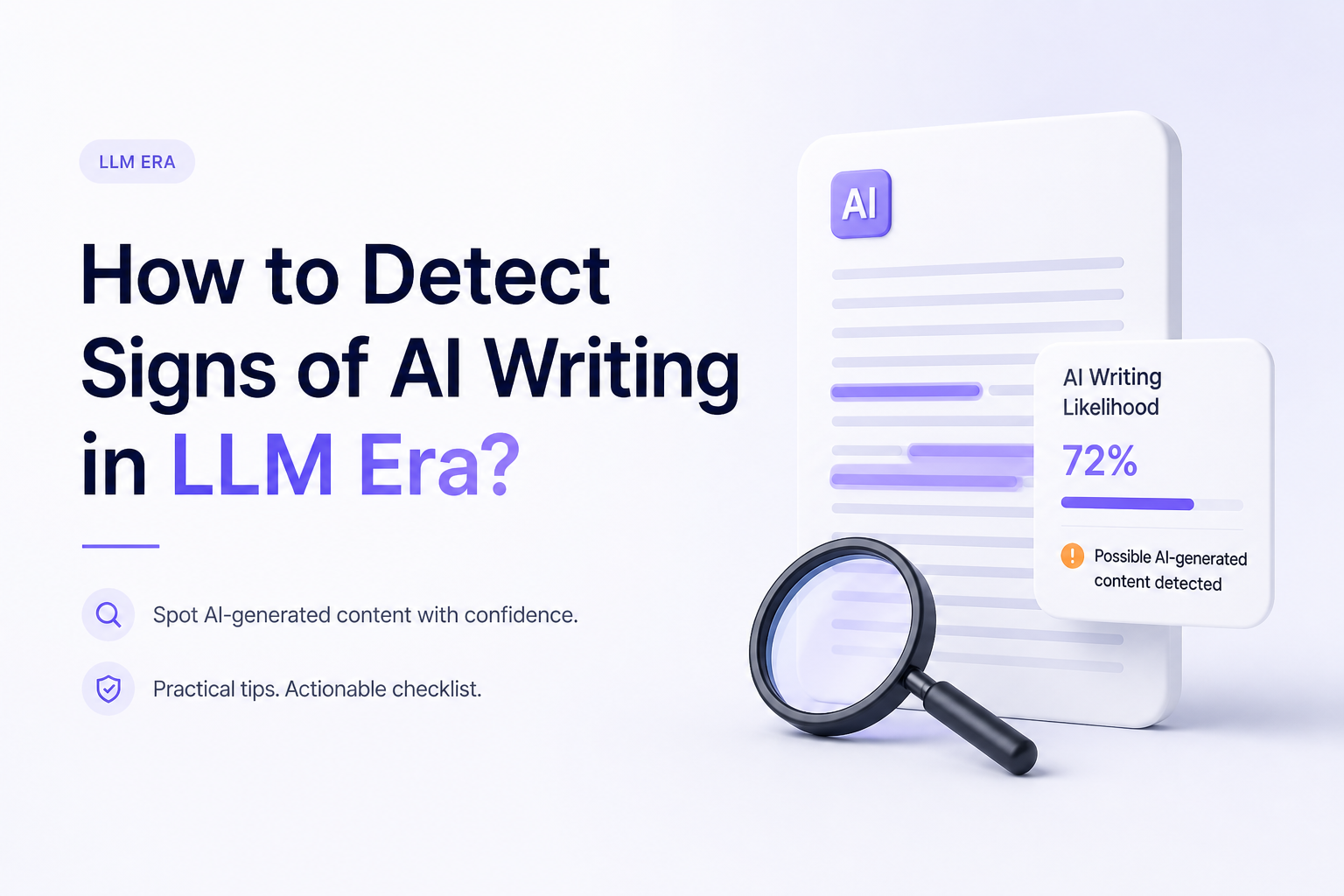
Scan for Sentence-Level AI Signals → Clever AI Detector
Shows an overall probability, confidence information, plus highlighted sentence signals · Accepts up to 10,000 words per check · English plus Spanish support
Top 5 Methods to Detect Signs of AI Writing
01 Scan the Draft With Clever AI Detector
Fastest for locating suspicious passages before doing a manual review
~2 min
Scan the Draft With Clever AI Detector
Fastest for locating suspicious passages before doing a manual review
Start with a broad statistical check, then inspect the sentences behind the score. Clever AI Detector reports an AI probability plus sentence-level signals, which makes it more useful for review than a bare yes-or-no label. (cleverhumanizer.ai)
- Open Clever AI Detector in your browser.
- Paste the full, unedited sample so the checker has enough context.
- Select Check for AI, then note the overall probability plus confidence level.
- Review each highlighted sentence instead of treating the total score as proof.
- Save the report, then compare its signals with the manual checks below.
02 Mark Repeated Language Patterns
Useful when the prose feels polished yet strangely interchangeable
~5 min
Mark Repeated Language Patterns
Useful when the prose feels polished yet strangely interchangeable
LLM output can settle into recurring transitions, sentence openings, summaries, or balanced constructions. Repetition alone proves nothing, though several patterns appearing together deserve a closer look.
- Highlight transition phrases such as however, moreover, or ultimately.
- Circle sentences that begin in nearly the same way.
- Look for repeated three-part lists or tidy contrasts.
- Search the document for phrases that sounded distinctive on first reading.
- Count how often the writer restates a point without adding evidence.
03 Test the Claims for Specificity
Best for exposing fluent passages built on thin evidence
~10 min
Test the Claims for Specificity
Best for exposing fluent passages built on thin evidence
Generated prose often sounds complete before it becomes concrete. Check whether names, dates, examples, quotations, plus citations actually support the argument.
- Underline every factual claim that an outside source could verify.
- Check whether each citation exists plus supports the nearby sentence.
- Replace broad claims with a request for a date, person, document, or measurable example.
- Watch for invented book titles, dead links, mixed-up authors, or quotations absent from the cited source.
- Compare the strongest paragraph with the source material for meaning, not just matching keywords.
04 Compare the Writer’s Voice Across Samples
Stronger when you have earlier work from the same person
~15 min
Compare the Writer’s Voice Across Samples
Stronger when you have earlier work from the same person
Authorship clues become clearer when compared with a genuine baseline. Focus on abrupt shifts in vocabulary, punctuation, confidence, paragraph shape, plus subject knowledge.
- Collect two or three earlier samples created under similar conditions.
- Compare average sentence length, favorite words, punctuation habits, plus paragraph size.
- Mark vocabulary that appears suddenly without a matching rise in subject knowledge.
- Check whether the new piece has lost the writer’s usual humor, hesitation, or rough edges.
- Ask the writer to explain one unusual phrase plus the reasoning behind a key paragraph.
05 Inspect the Draft History
Most useful when a decision could affect someone’s grade, job, or reputation
~10 min
Inspect the Draft History
Most useful when a decision could affect someone’s grade, job, or reputation
Process evidence is usually more meaningful than stylistic guesswork. Notes, outlines, revision history, source trails, plus rough drafts show how the text developed.
- Ask for the outline, research notes, source list, plus any early drafts.
- Open version history with the writer’s permission.
- Look for gradual revisions rather than a complete essay appearing in one paste.
- Check whether major claims can be traced to notes or source material.
- Discuss any unexplained gap before reaching a conclusion.
When an AI Detector Should Not Decide the Outcome
Do not use a detector score by itself to reject an application, penalize a student, accuse a freelancer, or question an employee’s honesty. Short samples, highly formal prose, translated text, plus heavy editing can create misleading signals.
If the consequences are serious, review sources, earlier work, drafts, assignment rules, plus the writer’s explanation. A tool can point toward questions. It cannot establish intent.
How to Review a Suspicious Passage Fairly
Suppose a report suddenly shifts from plain wording to flawless, abstract paragraphs. Scan the complete report, identify the flagged lines, then check whether those lines contain real examples or verifiable sources. Compare them with an earlier report from the same writer.
If the wording changed but the research trail is solid, the person may have used an editor or approved assistant. If citations are invented plus no drafts exist, you have a stronger reason to ask detailed questions.
Choose the Right Method for Detecting AI Writing
Begin with a scan, then move toward stronger contextual evidence.
| Method | Best for | Time | Success rate |
|---|---|---|---|
| 1. Scan the Draft With Clever AI Detector TRY FIRST | Fast initial screening | ~2 min | ● 88% |
| 2. Mark Repeated Language Patterns | Generic or formulaic prose | ~5 min | ● 72% |
| 3. Test the Claims for Specificity | Research-based writing | ~10 min | ● 78% |
| 4. Compare the Writer’s Voice Across Samples | Known authors or students | ~15 min | ● 81% |
| 5. Inspect the Draft History | High-stakes decisions | ~10 min | ● 90% |
Which AI-Writing Detection Method Should You Use?
Start with Clever AI Detector when you need a quick map of passages worth reviewing. Follow that scan with source verification plus a voice comparison. For a serious decision, draft history plus a calm conversation carry more weight than stylistic clues or one probability score.
Record several independent signals, preserve the original text, then ask the writer about the drafting process before drawing a conclusion.